Propagation, LOS/NLOS and Empirical Models
Path Loss and Propagation Mechanisms
Section titled “Path Loss and Propagation Mechanisms”Radio energy reaches the receiver by several mechanisms; a non-line-of-sight (NLOS) link relies on them when the direct line-of-sight (LOS) path is blocked.
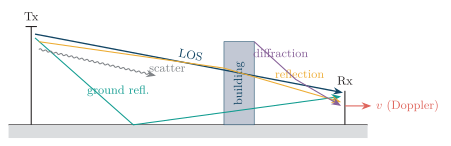
Multipath propagation: direct LOS plus ground/building reflection, rooftop diffraction and scattering; the building casts a shadow (NLOS) region and the moving mobile experiences Doppler.
| Mechanism | Description |
|---|---|
| Reflection | From surfaces large compared with |
| Diffraction | Bending around edges; gives some shadow-region coverage |
| Scattering | From rough surfaces / small objects; spreads energy widely |
| Shadowing | Slow log-normal variation behind obstacles |
Propagation mechanisms.
Multipath Fading and Doppler
Section titled “Multipath Fading and Doppler”Multipath components add constructively or destructively, causing fading.
| Fading | Meaning |
|---|---|
| Fast | Rapid variation from multipath + motion |
| Slow | Slow variation from shadowing |
| Flat | Signal bandwidth coherence bandwidth; one gain |
| Frequency-selective | Delay spread resolves paths ISI |
Fading classification.
Empirical Path-Loss Models: Okumura and Hata
Section titled “Empirical Path-Loss Models: Okumura and Hata”Free-space loss is optimistic for cluttered cellular routes, so measurement-based models are used in the 150–1500 MHz band.
Frequency Reuse
Section titled “Frequency Reuse”Frequency reuse assigns the full channel set once per cluster of cells, then repeats it in clusters far enough away to keep interference acceptable. Reuse factor .
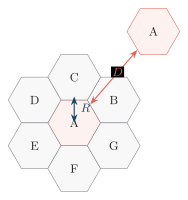
Seven-cell cluster (): cell radius and the reuse distance to the nearest co-channel cell using frequency group A.
Capacity Improvement
Section titled “Capacity Improvement”| Technique | Idea | Cost |
|---|---|---|
| Cell splitting | Split a congested cell into smaller cells | More sites, more handovers |
| Sectoring | Directional antennas (/) cut interferers | More antennas/handovers |
| Microcell zone | Zones share one base station | Reduces handoff burden |
Capacity-improvement methods.