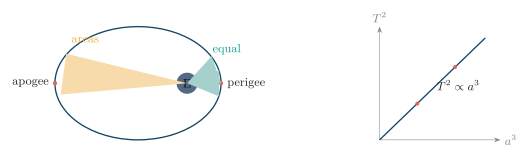
Example — Geostationary altitude from Kepler’s third law
For a geostationary satellite the period is one sidereal day, T=86164s. The orbital radius is
a=(4π2μT2)1/3≈42164km.Subtracting the Earth radius RE≈6378km,
h=a−RE≈35786km.[!NOTE]
Key Point — Why Kepler matters
The laws give the orbital period, fix the GEO altitude, predict satellite position for tracking, and explain the perigee/apogee speed variation used in Molniya-type HEO coverage.