Motivation and Leadership
Motivation is the internal and external force that energizes, directs, and sustains behavior toward the achievement of a goal.
Maslow’s Need Hierarchy
Section titled “Maslow’s Need Hierarchy”Maslow proposed that human needs form a hierarchy. A lower-order need normally requires substantial satisfaction before the next higher-order need becomes a dominant motivator.
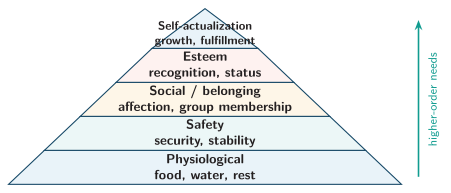
Maslow’s hierarchy of needs
-
Progression: Movement is generally upward, although regression can occur when a previously satisfied need is threatened.
-
Satisfaction: A substantially satisfied need loses much of its motivational power.
-
Limitation: Needs do not always follow one rigid order; culture, personality, and circumstances affect priority.
Herzberg’s Two-Factor Theory
Section titled “Herzberg’s Two-Factor Theory”Herzberg separated conditions that prevent dissatisfaction from features of the work itself that create positive satisfaction.
| Hygiene factors (dissatisfiers) | Motivators (satisfiers) |
|---|---|
| Company policy and administration | Achievement |
| Quality of supervision | Recognition |
| Salary and working conditions | The work itself |
| Interpersonal relations | Responsibility |
| Job security and status | Growth and advancement |
Herzberg’s hygiene factors and motivators
Managerial implication: Improving pay, policy, or conditions can remove dissatisfaction, but durable motivation usually requires job enrichment, responsibility, recognition, achievement, and growth.
McGregor’s Theory X and Theory Y
Section titled “McGregor’s Theory X and Theory Y”| Theory X assumptions | Theory Y assumptions |
|---|---|
| People inherently dislike work | Work can be as natural as play or rest |
| Direction, control, or coercion is necessary | Committed people exercise self-direction and self-control |
| People avoid responsibility | People can seek and accept responsibility |
| Security is the dominant concern | Creativity is widely distributed |
| Centralized authority is preferred | Participation and empowerment are useful |
Contrasting managerial assumptions about employees
Theory X and Theory Y are managerial assumptions, not two fixed types of worker. Those assumptions influence leadership style, controls, and job design.
Other Motivation Theories
Section titled “Other Motivation Theories”| Theory | Central idea |
|---|---|
| McClelland’s acquired needs | Behavior reflects learned needs for achievement (nAch), power (nPow), and affiliation (nAff) |
| Vroom’s expectancy theory | Motivation depends on expectancy that effort will produce performance, instrumentality that performance will produce reward, and the valence of that reward |
| Adams’ equity theory | People compare their input–outcome ratio with a referent and respond to perceived inequity |
Additional theories of work motivation
Leadership
Section titled “Leadership”Leadership is the ability to influence and guide individuals or groups toward the achievement of shared goals.
| Dimension | Leadership | Management |
|---|---|---|
| Focus | Vision, people, alignment, and change | Systems, structure, plans, and control |
| Primary action | Inspires and influences | Plans and organizes |
| Orientation | Longer-term and strategic | Nearer-term and operational |
| Source of authority | Personal influence and credibility | Formal position and delegated authority |
Leadership and management compared
Effective organizations need both: management creates dependable execution, while leadership supplies direction, commitment, and adaptation.
Leadership Styles
Section titled “Leadership Styles”| Style | Main behavior | Most suitable when |
|---|---|---|
| Style | Main behavior | Most suitable when |
| Autocratic | Leader decides and closely controls work | Urgent action is required or the workforce needs close direction |
| Team members contribute to decisions | The team is capable and commitment to a complex decision matters | |
| Laissez-faire | Leader delegates substantial freedom | Experts are skilled, responsible, and self-motivated |
| Transformational | Leader creates vision and inspires change | Innovation or organizational transformation is required |
| Transactional | Performance is exchanged for rewards or sanctions | Tasks, standards, and outputs are clear and routine |
| Situational | Leader adapts direction and support to follower readiness | competence and commitment vary by task or person |
Leadership styles and suitable conditions
Leadership Theories
Section titled “Leadership Theories”Trait theory.
Leadership is associated with traits such as intelligence, confidence, integrity, drive, and sociability.
Behavioral theory.
Effective leadership can be learned by developing task-oriented and people-oriented behaviors.
Fiedler’s contingency theory.
Effectiveness depends on matching a relatively stable leadership style with situational favorableness.
House’s path–goal theory.
The leader clarifies goals, removes obstacles, and selects directive, supportive, participative, or achievement-oriented behavior to help followers reach the goal.