Project Fundamentals and Life Cycle
A project is a temporary endeavor undertaken to create a unique product, service, or result. It has a defined beginning and end, specific objectives, interdependent activities, and constrained resources.
Project management is the application of knowledge, skills, tools, and techniques to project activities in order to meet agreed requirements and create the intended value.
Characteristics of a Project
Section titled “Characteristics of a Project”| Characteristic | Meaning |
|---|---|
| Temporary | Has definite start and completion conditions; temporary does not imply a short duration |
| Unique | Creates a product, service, result, or combination not identical to routine output |
| Progressive elaboration | Plans become more detailed as information and certainty improve |
| Resource-constrained | Competes for limited money, time, people, equipment, and materials |
| Goal-oriented | Exists to deliver defined objectives, benefits, and acceptance criteria |
| Cross-functional risk | Often joins several disciplines and faces uncertainty, dependencies, and stakeholders |
Defining characteristics of projects
The Triple Constraint
Section titled “The Triple Constraint”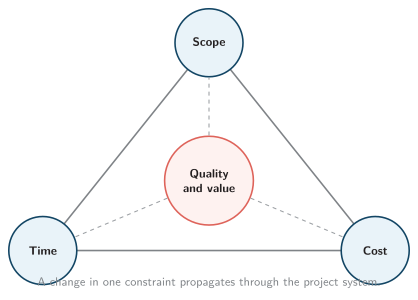
Project triple constraint, with quality and value at the center
Changing one constraint normally affects at least one other. More scope may require more time or cost; an imposed deadline may require more resources or a smaller scope. Quality is not an optional fourth trade-off: it expresses how well the delivered scope meets requirements.
Project Life Cycle
Section titled “Project Life Cycle”| Phase | Main activities | Typical outputs |
|---|---|---|
| Initiation | Define need, objectives, high-level scope, feasibility, sponsor, and stakeholders | Business case, feasibility report, project charter |
| Planning | Develop scope and WBS; estimate; schedule; budget; plan quality, resources, communication, procurement, and risk | Integrated project plan, baselines, WBS, schedule, budget, risk register |
| Execution | Direct project work, manage team and suppliers, assure quality, communicate, and produce deliverables | Accepted work results, issue log, progress information |
| Monitoring and controlling | Measure performance against baselines, forecast, control changes, risks, quality, schedule, and cost | Performance reports, forecasts, corrective actions, approved change requests |
| Closure | Obtain acceptance, hand over output, close contracts, release resources, archive records, and learn | Handover, closure report, final accounts, lessons learned |
Project life-cycle phases, activities, and outputs
Execution and monitoring/control overlap: the team performs work while managers measure it and intervene. The phases are logically distinct even when a project uses iterative or agile delivery.
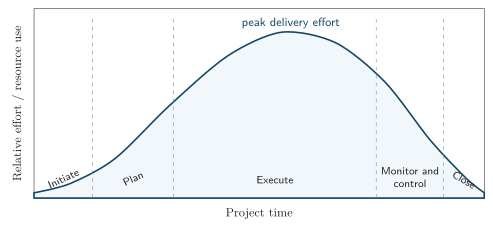
Typical effort profile over a predictive project life cycle
Key Project Documents
Section titled “Key Project Documents”| Document | Main phase | Purpose |
|---|---|---|
| Project charter | Initiation | Formally authorizes the project and gives the project manager authority; states high-level purpose and scope |
| Work breakdown structure (WBS) | Planning | Decomposes total deliverable scope into manageable work packages |
| Gantt chart / schedule | Planning and execution | Shows activities, timing, milestones, and progress |
| Risk register | Planning onward | Records risks, probability, impact, owner, response, triggers, and residual exposure |
| Progress report | Monitoring | Communicates actual versus planned status, forecasts, decisions, and exceptions |
| Lessons-learned register | Throughout and closure | Captures experience for current correction and future projects |
Documents that anchor project governance