Corporate Strategy, CSR, and Ethics
Corporate and Strategic Planning
Section titled “Corporate and Strategic Planning”Corporate planning defines the overall direction, objectives, portfolio, and resource allocation of the entire organization, usually over a three- to ten-year horizon.
It establishes the organization’s mission, vision, and values and aligns its business units. Strategic planning is the systematic process of analyzing the situation, choosing priorities and strategies, allocating resources, implementing action, and evaluating results.
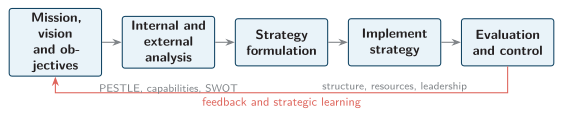
Strategic planning as an iterative management process
Environmental and SWOT analysis
Section titled “Environmental and SWOT analysis”-
External PESTLE: Political, economic, social, technological, legal, and environmental forces reveal opportunities and threats.
-
Internal analysis: Resources, capabilities, processes, culture, and core competencies reveal strengths and weaknesses.
| Source | Helpful to objectives | Harmful to objectives |
|---|---|---|
| Internal | Strengths | Weaknesses |
| External | Opportunities | Threats |
The logic of a SWOT analysis
| Tool | Main use |
|---|---|
| Porter’s Five Forces | Assesses industry rivalry, entry, substitutes, and the bargaining power of buyers and suppliers |
| BCG growth–share matrix | Classifies business units as stars, cash cows, question marks, or dogs using market growth and relative market share |
| Ansoff matrix | Frames growth through market penetration, market development, product development, or diversification |
| Balanced scorecard | Translates strategy into financial, customer, internal process, and learning-and-growth objectives and measures |
Frequently used strategic-management tools
Porter’s Five Forces
Section titled “Porter’s Five Forces”Industry attractiveness is shaped by (1) rivalry among existing competitors, (2) threat of new entrants, (3) threat of substitute products or services, (4) bargaining power of suppliers, and (5) bargaining power of buyers. High pressure from several forces tends to reduce industry profitability.
Corporate Social Responsibility
Section titled “Corporate Social Responsibility”Corporate social responsibility (CSR) is an organization’s responsibility to integrate economic, legal, ethical, social, and environmental concerns into its decisions and relationships with stakeholders.
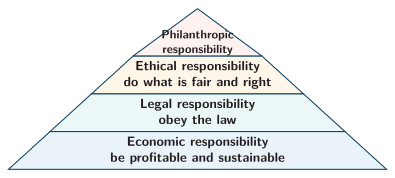
Carroll’s pyramid of corporate social responsibility
Triple bottom line: John Elkington’s framework evaluates organizational performance through people (social effects), planet (environmental effects), and profit (economic viability).
| Benefit | Mechanism |
|---|---|
| Brand and trust | Responsible conduct strengthens public legitimacy |
| Employee attraction | Purpose and fair treatment support recruitment and retention |
| Risk mitigation | Early attention to social, legal, and environmental effects reduces disruption and liability |
| Customer loyalty | Some customers prefer accountable providers |
| Investor confidence | Credible environmental, social, and governance practice can improve access to responsible capital |
Strategic benefits of responsible business practice
In Nepal, telecom CSR commonly includes rural connectivity, education, health, disaster support, digital inclusion, and environmental initiatives. Applicable company law, sector directives, and institution-specific requirements should be checked against their latest amendments.
Ethics, Integrity, and Responsibility
Section titled “Ethics, Integrity, and Responsibility”Business ethics examines the principles and standards that should govern organizational choices, conduct, and relationships with stakeholders.
| Principle | Practical meaning |
|---|---|
| Integrity | Act honestly and consistently with declared standards |
| Transparency | Make relevant information and decision processes visible |
| Fairness | Apply impartial criteria and treat stakeholders justly |
| Accountability | Accept responsibility, explain decisions, and correct harm |
| Respect | Protect dignity, rights, privacy, and legitimate interests |
Core ethical principles
Frequent ethical risks include conflicts of interest, corruption and bribery, discrimination, environmental harm, misuse of personal data, anti-competitive behavior, and retaliation against whistleblowers. In telecommunications, ethical conduct also requires transparent pricing, quality-of-service compliance, privacy and security, fair interconnection, and attention to universal service.
Business Strategy and Planning Horizons
Section titled “Business Strategy and Planning Horizons”| Dimension | Strategic planning | Operational planning |
|---|---|---|
| Scope | Organization or major business | Department, process, or activity |
| Horizon | Commonly three to ten years | Usually one year or less |
| Focus | Direction, positioning, and capability | Detailed execution and resource use |
| Primary owners | Top management | Middle and lower management |
| Uncertainty | High; assumptions are prominent | Lower; tasks and standards are more specific |
| Output | Broad priorities and strategic initiatives | Schedules, procedures, targets, and budgets |
Strategic and operational planning compared
Corporate strategy.
Determines which businesses or services the organization should enter, retain, combine, or exit.
Business strategy.
Determines how a unit will compete, commonly through cost leadership, differentiation, or focused service to a niche.
Functional strategy.
Aligns marketing, operations, human resources, finance, and technology with the business strategy.
Porter’s generic strategies are cost leadership across a broad market, differentiation through valued uniqueness, and focus on a narrow segment using either cost or differentiation. A firm that mixes these without a coherent value proposition risks being “stuck in the middle.”