Digital Schemes and Multiple Access
Digital Modulation for Wireless
Section titled “Digital Modulation for Wireless”-
BPSK: one bit per symbol; carrier phase ; two constellation points. Very robust, low spectral efficiency.
-
QPSK: two bits per symbol; four phases. OQPSK (offset QPSK) delays the Q channel by half a symbol so only one bit changes at a time: phase steps are limited to , avoiding transitions and large envelope dips (better for nonlinear amplifiers).
-
GMSK: Gaussian-filtered MSK: a constant-envelope, continuous-phase FSK-type scheme with a compact spectrum; used in GSM because it tolerates efficient nonlinear power amplifiers.
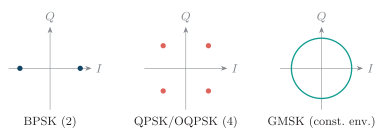
Signal-space views: BPSK (two antipodal points), QPSK/OQPSK (four points; OQPSK offsets Q to avoid jumps), and constant-envelope GMSK whose trajectory stays on a circle.
Multiple Access Techniques
Section titled “Multiple Access Techniques”| Technique | Separation | Used in |
|---|---|---|
| FDMA | Frequency bands | 1G analog |
| TDMA | Time slots on a carrier | GSM |
| CDMA | Spreading codes (shared band) | IS-95, WCDMA |
| OFDMA | Orthogonal subcarrier–time blocks | LTE, 5G NR downlink |
| SC-FDMA | DFT-spread OFDM (low PAPR) | LTE uplink |
| SDMA | Spatial beams/antennas | MIMO, 5G |
Multiple-access techniques.
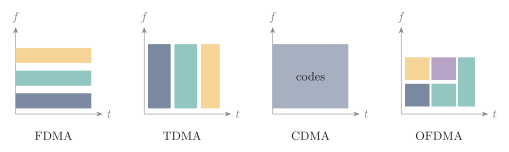
Resource sharing: FDMA (frequency bands), TDMA (time slots), CDMA (whole band shared via codes) and OFDMA (subcarrier–time resource blocks).
Handover
Section titled “Handover”Handover (handoff) transfers an ongoing call/session from one cell, sector, channel, beam or RAT to another without interrupting service.
It is triggered by falling RSS/RSRP or SINR, rising interference/BER, cell overload or a better available cell. To avoid the ping-pong effect, a neighbour must lead by a hysteresis margin for a time-to-trigger:
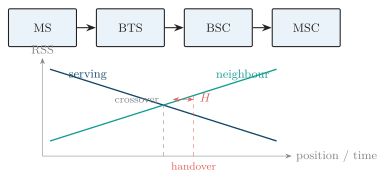
Architecture (MSBTSBSCMSC) and the serving/neighbour RSS crossover: handover fires only after the neighbour leads by the hysteresis margin .
| Type | Operation / example |
|---|---|
| Hard | Break-before-make; old link released first (GSM, LTE) |
| Soft | Make-before-break; two links combined briefly (CDMA) |
| Softer | Between sectors of the same base station |
| Horizontal | Between cells of the same RAT (LTELTE) |
| Vertical / inter-system | Between different RATs (Wi-FiLTE, NRLTE) |
| Intra-/inter-cell | Channel change within a cell / transfer between cells |
Handover types.
GSM uses mobile-assisted handover (MAHO): the mobile measures neighbour levels and reports them; the network decides. LTE/5G use hard handover controlled by the eNodeB/gNodeB, with 5G adding beam-level mobility and LTE–NR interworking.