Marketing and Product Planning
Marketing is the process of understanding chosen customers, creating and communicating a valuable offering, delivering it through suitable channels, and managing exchange relationships profitably and responsibly.
Philip Kotler describes marketing as a social and managerial process through which people obtain what they need and want by creating and exchanging products and value.
The Marketing Process
Section titled “The Marketing Process”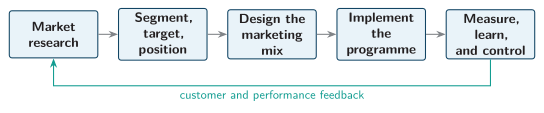
The marketing process from insight to controlled execution
-
Research customer needs, demand, market size, trends, and competitors.
-
Segment the market, select attractive targets, and define positioning.
-
Design the product, price, place, and promotion programme, extended for services by people, process, and physical evidence.
-
Implement the programme with responsibilities, resources, and schedules.
-
Measure outcomes such as response, acquisition, retention, share, and return on marketing investment; learn and adjust.
Segmentation, Targeting, and Positioning
Section titled “Segmentation, Targeting, and Positioning”| Basis | Typical variables | Telecom example |
|---|---|---|
| Geographic | Region, density, climate, urban/rural | Coverage and offers adapted to remote and urban areas |
| Demographic | Age, income, occupation, education | Student, household, and enterprise plans |
| Psychographic | Lifestyle, values, interests, personality | Convenience-led, premium, or value-oriented users |
| Behavioral | Usage, benefit sought, loyalty, readiness | Heavy-data users, prepaid/postpaid, or loyalty segments |
Common bases for consumer-market segmentation
Targeting: evaluates segment size, growth, accessibility, competition, and strategic fit before choosing whom to serve. Positioning: creates a clear, distinctive, and credible place for the offer in the target customer’s mind relative to alternatives.
Product Planning
Section titled “Product Planning”Core product.
The fundamental benefit sought, such as communication.
Actual product.
The brand, quality, features, design, and packaging that deliver the benefit, such as an NTC 4G SIM and service plan.
Augmented product.
Additional support, warranty, delivery, self-service, and after-sales care surrounding the actual offer.
Product life cycle
Section titled “Product life cycle”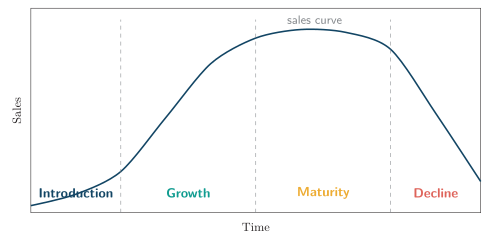
Typical product life-cycle pattern
| Stage | Typical condition | Marketing response |
|---|---|---|
| Introduction | Low sales, high unit cost, little or no profit | Build awareness, trial, and suitable distribution |
| Growth | Rapid sales growth, improving profit, new competitors | Differentiate, improve the offer, and expand channels |
| Maturity | Peak or slowing sales, saturation, intense competition | Defend share, modify market/product/mix, and improve efficiency |
| Decline | Falling demand due to substitution or obsolescence | Reposition, harvest, retain a niche, or divest |
Product life-cycle conditions and responses
The life-cycle pattern is a diagnostic model, not a fixed timetable. Product category, brand, and technology cycles may differ, and management action can extend or reshape a stage.
New-product development
Section titled “New-product development”The usual sequence is idea generation screening concept development and testing business analysis product development test marketing commercialization. Screening should become progressively more evidence-based as investment rises.
Developing the Marketing Programme
Section titled “Developing the Marketing Programme”The traditional 4Ps
Section titled “The traditional 4Ps”| Element | Decision area | Telecom illustration |
|---|---|---|
| Product | Features, quality, brand, variety, and support | Voice, broadband, data packs, roaming, and enterprise services |
| Price | List price, discounts, bundles, credit, and payment terms | Prepaid, postpaid, usage, subscription, and bundle rates |
| Place | Coverage, channels, inventory, access, and delivery | Retail outlets, agents, app, website, and network coverage |
| Promotion | Advertising, sales promotion, selling, PR, and direct contact | Broadcast ads, bonus data, sponsorship, SMS, and account managers |
The marketing mix for a telecom service
The additional 3Ps for services
Section titled “The additional 3Ps for services”| Element | Meaning | Telecom illustration |
|---|---|---|
| People | Employees and others who shape the service encounter | Customer-care agents, technicians, installers, and sales staff |
| Process | Procedures and flow through which service is delivered | SIM activation, billing, fault repair, and complaint resolution |
| Physical evidence | Tangible cues that make an intangible service credible | Stores, bills, uniforms, equipment, website, and visible network assets |
Extending the mix from 4Ps to 7Ps
Pricing Strategies
Section titled “Pricing Strategies”| Strategy | Logic | Illustration |
|---|---|---|
| Penetration | Low initial price builds adoption and share quickly | Introductory data or broadband offer |
| Market skimming | High initial price captures willingness to pay before later reductions | Early premium technology service |
| Competitive | Price is set with close reference to rivals | Comparable voice and data rates |
| Bundle | Several services are sold together below separate total prices | Voice, data, and SMS pack |
| Freemium | Basic access is free while enhanced use is paid | Limited free tier with paid capacity or features |
Common pricing strategies
Promotion Mix
Section titled “Promotion Mix”| Tool | Character | Example |
|---|---|---|
| Advertising | Paid, identified, non-personal communication | Television, radio, print, outdoor, and digital ads |
| Sales promotion | Short-term incentive to stimulate action | Bonus data, price-off offer, or contest |
| Personal selling | Direct interaction tailored to a buyer | Enterprise account manager |
| Public relations | Earned attention and stakeholder relationships | Media relations, CSR event, or sponsorship |
| Direct marketing | Addressable contact seeking a response | Permission-based SMS, email, app notification, or call |
Integrated marketing-communication tools