PCM and ADPCM
Digital Speech-Coding Context
Section titled “Digital Speech-Coding Context”An analog speech waveform is continuous in time and amplitude; a waveform coder converts it to digital form while preserving enough sample information for acceptable reconstruction. The main families are:
-
PCM: encode the absolute quantized sample.
-
DPCM: predict the sample and encode only the prediction error.
-
ADPCM: adapt the predictor and/or quantizer to changing speech statistics.
-
Delta modulation: one-bit differential coding with an oversampled staircase.
Pulse Code Modulation (PCM)
Section titled “Pulse Code Modulation (PCM)”Pulse Code Modulation (PCM) represents each analog sample by a binary codeword. Its three defining operations are sampling (values taken every ), quantization (each value rounded to one of levels) and encoding (the selected level written as an -bit word).
PCM is digital even though its source is analog; PAM alone is not digital because its pulse amplitudes remain continuous.
PCM Transmitter
Section titled “PCM Transmitter”
PCM transmitter: the anti-alias LPF enforces ; stable samples are optionally compressed, uniformly quantized and encoded, then a serializer/line coder forms the clock-recoverable channel waveform.
Before sampling, the anti-alias LPF limits the retained message band to ; the sample-and-hold then presents a stable value to the quantizer. An optional A-law/-law compressor before a uniform quantizer reduces dynamic range so weak speech gets finer effective resolution. The encoder forms an -bit codeword, after which parallel-to-serial conversion and line coding produce a channel waveform from which timing can be recovered. Thus the encoder output is a sequence of codewords, not a direct copy of the analog waveform.
PCM Receiver
Section titled “PCM Receiver”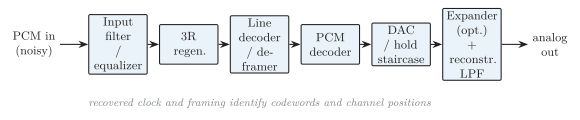
PCM receiver: input filtering limits noise and equalizes the channel; 3R regeneration and de-framing recover timed channel codewords; decoding, DAC/hold, optional expansion and reconstruction filtering recover the waveform.
The input filter/equalizer limits out-of-band noise as well as compensating channel distortion. After 3R regeneration and clock/frame recovery, the line decoder/de-framer recovers binary codewords and their channel positions. The PCM decoder maps each word to a quantized level; a DAC/hold creates the corresponding staircase, an expander (when used) inverts compression, and the reconstruction LPF suppresses sampling images and smooths the output. The result still differs from the original by quantization error and any bit errors or filtering distortion.
Bit Rate, Bandwidth and SQNR
Section titled “Bit Rate, Bandwidth and SQNR”is a theoretical zero-ISI lower bound for two-level signaling; the actual occupied bandwidth depends on line code, pulse shaping and roll-off (Manchester, e.g., needs more than shaped NRZ).
Under the usual uniform-error model for an ideal, uniform, non-overloaded quantizer, the error is treated as uniformly distributed over and uncorrelated with the input. Then
Each extra bit adds of ideal SQNR but raises by .
| Quantity | Value |
|---|---|
| Speech passband | – 3400 Hz |
| Sampling rate | 8 kHz |
| Sampling period | |
| Codeword length | 8 bit/Sa |
| Channel bit rate | 64 kbit/s |
Standard telephone PCM parameters.
Companding, Bit Errors and Advantages
Section titled “Companding, Bit Errors and Advantages”Speech has a large dynamic range and dwells near zero, so A-law/-law compression allocates finer steps to weak signals; the receiver expands. In exchange, it can penalize or distort large signals relative to a uniform quantizer with the same nominal near-full-scale step. In natural-binary PCM an MSB error changes a sample far more than an LSB error, so a low channel BER and reliable synchronization are essential. Gray coding can make adjacent quantizer indices differ by one bit, but this is distinct from the standardized code assignments used by conventional telephony PCM.
Advantages: 3R regeneration stops noise accumulation, quality is stable over long links, digital processing/encryption/storage/error control are easy, and one TDM/switching network can carry voice, data and signaling with repeatable IC characteristics. Costs: extra bandwidth, unavoidable quantization noise, accurate sampling plus bit/frame synchronization, and converter/timing circuitry that adds complexity and power consumption.
PCM Framing and Synchronization
Section titled “PCM Framing and Synchronization”A multiplexed PCM receiver must find bit boundaries, the bits of one word, frame boundaries and each channel’s time slot. Framing patterns (E1/T1) provide alignment; loss of frame alignment misroutes sample words even when bits are correct. Line coding (e.g. HDB3) maintains physical timing transitions, while framing identifies the logical TDM structure — different functions. An E1 frame has TS0 plus 31 remaining time slots. In the common PCM30/CAS arrangement, TS16 carries channel-associated signaling and TS1–TS15 plus TS17–TS31 carry 30 voice channels; the 31 non-TS0 slots must therefore not all be called channel slots.
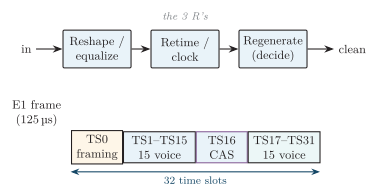
Regenerative repeater performs the three R’s (reshape/equalize, retime/clock, regenerate). E1 has TS0 plus 31 remaining slots; in PCM30/CAS, TS16 carries signaling and the other 30 non-TS0 slots carry voice channels.
Differential PCM (DPCM)
Section titled “Differential PCM (DPCM)”Adjacent speech samples are strongly correlated. DPCM predicts the current sample from previous reconstructed samples and transmits only the difference.
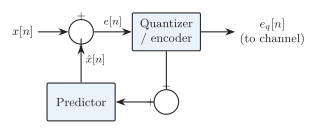
DPCM transmitter: the predicted value is subtracted from the input, the error is quantized/encoded, and the local reconstruction feeds a predictor identical to the decoder’s.
If prediction is effective, has lower variance than and can be quantized with fewer bits for the same distortion. Limitations: predictor state must stay synchronized, quantization error feeds the loop, and channel errors can disturb several later samples. Prediction also gives little saving for rapidly changing or uncorrelated signals.
Adaptive Differential PCM (ADPCM)
Section titled “Adaptive Differential PCM (ADPCM)”ADPCM improves DPCM by adapting its quantizer step size and/or predictor coefficients to recent signal behaviour: larger step for fast/large signals, smaller for weak/slow ones.
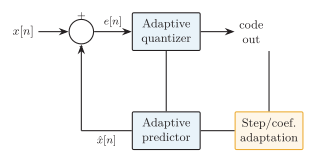
ADPCM codec: a DPCM loop in which both the quantizer step and the predictor coefficients are adapted from reconstructed history (ITU-T G.726).
The decoder must perform the identical predictor and quantizer adaptation from the same reconstructed history; otherwise the two adaptive states diverge.
G.726 supports 16, 24, 32 and 40 kbit/s; the 32 kbit/s mode halves the PCM rate with useful telephony quality. ADPCM has moderate computational complexity and has been used for speech storage, cordless telephony and legacy digital voice links. Costs: more state dependence, possible error propagation and lower transparency for arbitrary audio.
Delta Modulation and ADM
Section titled “Delta Modulation and ADM”Delta modulation (DM) is one-bit DPCM: at each (oversampled) instant it sends only whether the local staircase should rise or fall by fixed step (bit 1 , bit 0 ). The receiver integrates the bits and low-pass filters the staircase.
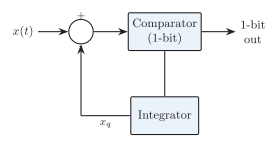
Delta-modulation encoder: a comparator emits one bit per sample and a feedback integrator builds the staircase estimate used for the next comparison.
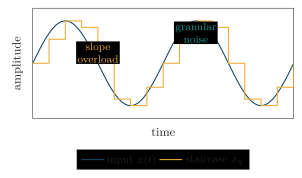
DM staircase versus input: too small lags a steep input (slope overload); too large hunts about a flat input (granular noise). ADM adapts (increase on runs of equal bits, decrease on alternating bits) to reduce both.
Increasing also improves staircase tracking, but DM sends one bit at every sample, so its bit rate rises by the same factor. Its very simple one-bit format suits low-rate voice and control links where high-fidelity audio is not required.
Coder Comparison
Section titled “Coder Comparison”| Feature | PCM | DPCM | ADPCM | DM |
|---|---|---|---|---|
| Encoded value | Absolute sample | Prediction error | Adaptive pred. error | Sign of 1-step error |
| Bits/sample | Several (8) | Fewer than PCM | Often 4 (speech) | |
| Sample rate | Nyquist margin | PCM | PCM | Much higher (oversample) |
| Typical rate | kbit/s | PCM | kbit/s | |
| Complexity | Moderate | Predictor | Adaptive pred. & quant. | Simplest format |
| Main impairment | Quant. noise | Pred. quant. error | Adaptation / propagation | Slope overload, granular |
| Typical use | General telephony/audio | Correlated waveforms | Speech, cordless, legacy | Low-rate voice/control |
Comparison of PCM, DPCM, ADPCM and delta modulation.