Management Foundations
Management is the process of planning, organizing, leading, coordinating, and controlling human, financial, material, and informational resources to achieve organizational goals effectively and efficiently.
Mary Parker Follett described management as “the art of getting things done through people.” Henri Fayol emphasized forecasting and planning, organizing, commanding, coordinating, and controlling. Together, these views capture both the human and process dimensions of management.
Functions of Management
Section titled “Functions of Management”| Function | Central question | Typical activities |
|---|---|---|
| Function | Central question | Typical activities |
| Planning | What must be achieved and how? | Goals, forecasts, strategies, policies, programmes, schedules, and budgets |
| Organizing | Who will do what with which resources? | Work division, departmentalization, staffing, delegation, and authority relationships |
| How will people be guided toward the goal? | Direction, motivation, communication, supervision, and conflict resolution | |
| Coordinating | How will separate efforts remain aligned? | Integrating schedules, information, people, and interdependent departmental work |
| Controlling | Are results matching the plan? | Standards, measurement, variance analysis, feedback, and corrective action |
Fayol’s five management functions in modern terms
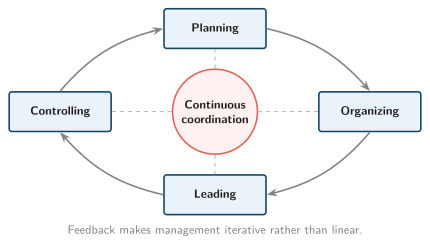
The management cycle with coordination linking every function
Levels of Management
Section titled “Levels of Management”| Level | Dominant role | Typical positions |
|---|---|---|
| Level | Dominant role | Typical positions |
| Top management | Establishes vision, policy, long-term strategy, and the organization-wide allocation of resources | Board of directors, chief executive officer, managing director |
| Middle management | Translates strategy into departmental plans and coordinates units, budgets, and performance | Department head, division chief, branch manager |
| Directs day-to-day operations and monitors frontline quality, output, safety, and discipline | Supervisor, foreperson, team leader |
Management levels and their dominant responsibilities
Decision horizon: Top managers face broad, long-term, and less-structured decisions; lower managers face narrower, short-term, and more structured decisions. The need for conceptual skill rises toward the top, whereas technical skill is especially important near operations.
Evolution of Management Thought
Section titled “Evolution of Management Thought”Classical approaches
Section titled “Classical approaches”Scientific management – F. W. Taylor (1911).
Improves operational efficiency through work study, scientific task design, worker selection and training, and cooperation between management and labor. Its principles favor science over rule of thumb, harmony over discord, cooperation over individualism, maximum output, and worker development.
Administrative theory – Henri Fayol (1916).
Examines management as a whole. Key principles include division of work; parity of authority and responsibility; unity of command; unity of direction; scalar chain; discipline; equity; and esprit de corps.
Bureaucratic theory – Max Weber.
Uses a formal hierarchy, division of labor, explicit rules, impersonal decisions, documented procedures, and merit-based appointment and promotion.
Behavioral and human-relations approaches
Section titled “Behavioral and human-relations approaches”Elton Mayo’s Hawthorne studies highlighted the effects of attention, social relations, group norms, and employee attitudes on productivity. Later work by Abraham Maslow and Douglas McGregor placed needs, motivation, participation, and managerial assumptions about workers at the center of organizational behavior.
Modern approaches
Section titled “Modern approaches”| Approach | Core proposition | Managerial implication |
|---|---|---|
| Systems | An organization is an open system of interdependent subsystems that transforms inputs into outputs and learns through feedback | Optimize the whole system, not an isolated department |
| Contingency | No management method is universally best; the appropriate choice depends on environment, technology, task, and people | Diagnose the situation before selecting structure or leadership style |
| Quantitative | Mathematical models, statistics, operations research, and analytics improve complex decisions | Compare alternatives with explicit data, constraints, and criteria |
| Total quality management | Customer focus, employee involvement, process control, and continuous improvement create durable quality | Build quality into processes instead of relying only on final inspection |
Modern approaches to management