Evolution 1G to 5G
Wireless Communication
Section titled “Wireless Communication”Wireless communication transfers information between points without physical conductors, using electromagnetic waves (radio, microwave, infrared, satellite).
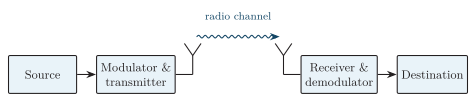
Basic wireless link: source modulator/transmitter antenna radio channel antenna receiver/demodulator destination.
Evolution from 1G to 5G
Section titled “Evolution from 1G to 5G”| Gen | Era | Technology / access | Key service |
|---|---|---|---|
| 1G | 1980s | Analog FM, FDMA | Analog voice |
| 2G | 1990s | GSM (TDMA), IS-95 (CDMA) | Digital voice, SMS |
| 2.5/2.75G | late 1990s | GPRS, EDGE | Packet data |
| 3G | 2000s | WCDMA/UMTS, CDMA2000 | Mobile broadband, video call |
| 4G | 2010s | LTE: OFDMA, MIMO | All-IP broadband, VoLTE |
| 5G | 2020s | NR: massive MIMO, mmWave, slicing | eMBB, URLLC, mMTC |
Mobile-generation summary.
-
1G: analog, voice-only, FDMA, low capacity/weak security (AMPS, NMT, TACS).
-
2G: digital voice + SMS, encryption, better efficiency; GPRS/EDGE add packet data.
-
3G: multimedia and mobile internet (WCDMA/CDMA2000).
-
4G: all-IP, OFDMA + MIMO, high data rate (LTE/LTE-A, VoLTE).
-
5G: NR air interface, sub-6 GHz + mmWave, massive MIMO, beamforming, small cells, network slicing, edge computing.
| 5G class | Meaning | Examples |
|---|---|---|
| eMBB | Enhanced Mobile Broadband | 4K/8K video, fast internet |
| URLLC | Ultra-Reliable Low-Latency | Remote control, automation |
| mMTC | Massive Machine-Type Comm. | IoT sensors, smart meters |
5G service categories.
Each generation approaches a larger useful fraction of this Shannon limit through higher-order modulation, stronger coding, wider aggregated bandwidth and spatial multiplexing (MIMO).
The Cellular Concept
Section titled “The Cellular Concept”The cellular concept divides a service area into many small cells, each served by a low-power base station; the same channels are reused in cells separated by enough distance.
Benefits: higher capacity through frequency reuse, lower transmit power, planned coverage, mobility and handover support. Real coverage is irregular, but hexagons are used as a planning model because they tessellate without gaps/overlaps, approximate a circle better than a square, give six equidistant neighbours and simple reuse geometry.
| Cell | Coverage | Use |
|---|---|---|
| Macrocell | Several km | Rural / wide area |
| Microcell | m–few km | Urban |
| Picocell | Tens of metres | Offices, malls |
| Femtocell | Home/small office | Indoor (broadband backhaul) |
| Small cell | Umbrella term | Low-power cells for dense-area capacity |
Cell types by coverage.
Cellular Network Architecture
Section titled “Cellular Network Architecture”| GSM element | Function |
|---|---|
| MS | Mobile station (handset + SIM) |
| BTS | Base transceiver station (radio for a cell) |
| BSC | Base station controller (controls BTSs, handovers) |
| MSC | Mobile switching centre (switching, mobility) |
| HLR / VLR | Home / visitor location register (subscriber databases) |
| AuC / EIR | Authentication centre / equipment identity register |
GSM core elements.
| LTE/5G element | Function |
|---|---|
| eNodeB / gNodeB | LTE / 5G NR base station |
| EPC / 5GC | LTE / 5G core network |
| AMF | Access and mobility management (5G) |
| UPF | User-plane data forwarding (5G) |
LTE/5G architecture terms.