Telecommunications Act, Regulation, and Sector Controls
Purpose and Architecture of the Act
Section titled “Purpose and Architecture of the Act”The Telecommunications Act, 2053 (1997) replaced the Telecommunications Act, 2019 and established the modern legal framework for reliable and accessible service, private-sector participation, regulation, licensing, consumer interest, and sector development. The supplied text identifies 11 chapters and 63 sections; use the latest consolidated official publication where amendments alter numbering or substance.
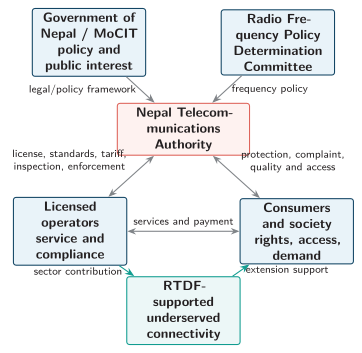
Institutional architecture of Nepal’s telecommunications sector
Licensing
Section titled “Licensing”-
License requirement: Section 21 prohibits operation of a telecommunications service without the required license.
-
Application and issue: The source associates license issue with Section 24 and a decision period of 90 days.
-
Term: Section 25 provides a maximum license horizon of 25 years, with issue for no more than 10 years at one time under the base text.
-
Renewal: The source states renewal for periods not exceeding five years at a time, subject to the current legal process.
-
Competition: Where several qualified applicants compete, the Act may use bidding on license fee, renewal fee, and royalty under the applicable procedure.
-
Transfer/cancellation: Transfer requires regulatory approval; Section 28 addresses cancellation for non-operation or violation after due process.
The Telecommunications Regulation, 2054 supplies procedures, forms, fees, renewal rules, frequency administration, quality and service conditions under the Act. It is not static: an official/legal update identified a tenth amendment concerning re-issuance after an initial 25-year term. Answers must therefore specify whether they describe the base Act, an amendment, or the current consolidated rule.
Royalty and Rural Telecommunications Development Fund
Section titled “Royalty and Rural Telecommunications Development Fund”Section 32 requires licensees to pay royalty as prescribed or committed through the licensing process. Section 30 establishes the Rural Telecommunications Development Fund (RTDF), funded by the prescribed share of licensee income and used to develop and extend service in rural or underserved areas.
Policy logic: Commercial rollout naturally favors dense and profitable areas; a universal-service fund pools sector contributions to finance socially valuable coverage that the market might otherwise delay.
Radio-Frequency Governance
Section titled “Radio-Frequency Governance”Section 49 provides for the Radio Frequency Policy Determination Committee. The source describes a committee chaired by the minister responsible for communications, with relevant government secretaries and the NTA chairperson. It determines frequency policy, allocation, and pricing at the policy level; NTA performs frequency-related regulatory work in accordance with that policy.
Spectrum governance normally separates:
-
national allocation and policy;
-
assignment or authorization to users/licensees;
-
technical conditions and coordination;
-
monitoring, interference control, and enforcement; and
-
fees, efficient use, refarming, sharing, or future-band planning.
Government Powers, Offences, and Appeal
Section titled “Government Powers, Offences, and Appeal”The Act gives government special powers over telecommunications in legally defined emergency or national-security circumstances, including takeover or control of lines and restriction, tracing, or interception as authorized by law. Such powers must be read with current constitutional, privacy, criminal, and procedural safeguards.
| Conduct | Supplied base-text consequence |
|---|---|
| Contravention of Act or lawful order | Fine up to Rs. 50,000 |
| Operation without required license | Fine up to Rs. 50,000 plus stoppage |
| Harassment through telecommunications | Fine up to Rs. 25,000 plus stoppage |
| Damage to line or system | Compensation/fine linked to damage, imprisonment up to five years, or both as applicable |
| Appeal | Appeal within 35 days to the prescribed body under the source summary |
Base-text penalty figures summarized in the supplied notes
Tariff and Consumer Regulation
Section titled “Tariff and Consumer Regulation”Section 42 and NTA’s Section 13 functions connect tariff approval with broader consumer protection. Regulatory analysis should consider cost, reasonable return, affordability, competition, non-discrimination, transparency, service quality, interconnection, and universal-service obligations rather than treating tariff as an isolated price list.