Accounting Foundations and Cost Analysis
Business and Accounting Terminology
Section titled “Business and Accounting Terminology”| Term | Meaning |
|---|---|
| Asset | A present economic resource controlled by the entity as a result of past events, such as cash, receivables, property, or equipment |
| Liability | A present obligation whose settlement is expected to transfer an economic resource, such as a loan or account payable |
| Equity | Residual interest in assets after deducting liabilities |
| Revenue | Income arising in ordinary activities, such as service charges |
| Expense | Consumption or loss of economic benefits in earning revenue |
| Profit / net income | Revenue and other income less expenses for the period |
| Capital | Funds or other resources contributed by owners |
| Dividend | Distribution of eligible profit to shareholders |
| Working capital | Current assets minus current liabilities; a net measure of short-term liquidity committed to operations |
Core business terms
| Term | Meaning |
|---|---|
| Debit (Dr) | Left side of an account; normally increases assets and expenses and decreases liabilities, equity, and income |
| Credit (Cr) | Right side of an account; normally increases liabilities, equity, and income and decreases assets and expenses |
| Journal | Chronological record in which transactions are first entered |
| Ledger | Classified collection of individual accounts to which journal entries are posted |
| Fiscal year | Twelve-month reporting period; Nepal’s government fiscal year runs from Shrawan through Ashad |
| Accrual basis | Recognizes economic events when earned or incurred, not only when cash is received or paid |
| Cash basis | Recognizes transactions when cash changes hands |
Essential accounting vocabulary
Cost Classification
Section titled “Cost Classification”Classification by behavior
Section titled “Classification by behavior”| Type | Behavior | Example |
|---|---|---|
| Fixed cost | Total remains constant as activity changes within a relevant range; fixed cost per unit falls as volume rises | Building rent, salaried supervision, insurance |
| Variable cost | Total changes in proportion to the activity driver; per-unit amount is constant under the model | Direct material, usage commission |
| Mixed / semi-variable | Contains both fixed and variable components | Utility or telecom bill with base charge plus usage |
Cost behavior within the relevant range
Classification by function and traceability
Section titled “Classification by function and traceability”| Function | Coverage | Example |
|---|---|---|
| Production / manufacturing | Costs of creating the product or operating the productive service process | Material, factory labor, network operations |
| Administrative | General management and office support | Office rent, administration salaries |
| Selling and distribution | Demand creation, sales, and delivery | Advertising, commission, transport |
| Finance | Cost of obtaining and managing funds | Interest and financing fees |
Cost classification by organizational function
Direct cost: can be economically traced to a particular cost object, such as a product or project. Indirect cost: supports several cost objects and must be allocated using a defensible cost driver. Direct does not necessarily mean variable, and indirect does not necessarily mean fixed.
Break-Even and Contribution Analysis
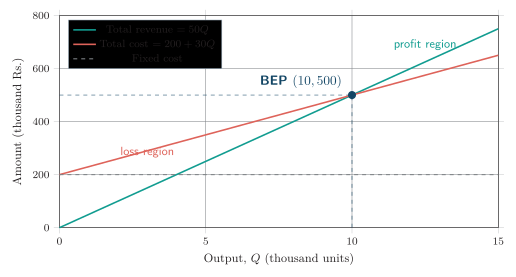
Section titled “Break-Even and Contribution Analysis”The break-even point is the activity level at which total revenue equals total cost, so operating profit is zero.
Break-even chart for the worked example