Procurement and Competitive Bidding
Procurement is the governed process of identifying need and acquiring goods, works, or services from external sources with due attention to value for money, fairness, competition, transparency, integrity, and accountability.
Incoterms in International Trade
Section titled “Incoterms in International Trade”| Rule | Full name | Main allocation |
|---|---|---|
| EXW | Ex Works | Seller places goods at buyer’s disposal at the named place; buyer bears most transport and clearance responsibility |
| FCA | Free Carrier | Seller delivers cleared goods to the carrier or person nominated by the buyer at the named place |
| FOB | Free on Board | For sea/inland-waterway transport, seller loads goods on the buyer-nominated vessel; risk transfers when goods are on board |
| CFR | Cost and Freight | Seller pays freight to named destination port, but risk transfers when goods are on board at origin; insurance is not included |
| CIF | Cost, Insurance and Freight | As CFR, plus seller procures the required minimum cargo insurance; cost destination and risk-transfer points differ |
| DDP | Delivered Duty Paid | Seller bears maximum delivery obligation, including import clearance and duties, to the named destination |
Selected Incoterms 2020 rules
Financial Instruments and Contract Security
Section titled “Financial Instruments and Contract Security”| Instrument | Mechanism | Protection |
|---|---|---|
| Letter of credit (LC) | Issuing bank undertakes to honor a compliant documentary presentation | Reduces seller’s payment risk while preserving documentary conditions for buyer |
| Bank guarantee | Bank pays the beneficiary upon a conforming demand under the guarantee | Supports obligations such as payment or performance |
| Bid security / earnest money | Bidder provides security with the offer, often an amount or percentage stated in the bidding document | Discourages withdrawal, refusal to sign, or failure to provide performance security |
| Performance security | Successful supplier secures contractual performance, often around 5–10% where specified | Protects purchaser against default |
| Advance-payment guarantee | Secures recovery of mobilization or other advance | Protects funds paid before equivalent delivery |
| Retention money | Purchaser withholds an agreed portion until contractual conditions or defect obligations are met | Incentivizes correction and completion |
Common procurement instruments
Percentages are illustrative conventions, not universal rules; the current law, standard bidding document, and signed contract govern each procurement.
Liquidated Damages
Section titled “Liquidated Damages”Liquidated damages (LD) are an agreed amount payable for a specified breach such as delay. They should represent a reasonable pre-estimate or contractual allocation of loss rather than an unenforceable penalty, subject to governing law.
Contract Types and Risk Allocation
Section titled “Contract Types and Risk Allocation”| Type | Payment basis | Dominant cost risk |
|---|---|---|
| Lump sum / fixed price | Fixed amount for a well-defined scope | Supplier, except approved changes and allocated risks |
| Unit rate | Agreed rate multiplied by measured quantity | Quantity risk leans to purchaser; unit productivity risk leans to supplier |
| Cost plus | Allowable actual cost plus fee or percentage | Purchaser unless incentives, ceilings, and audit controls shift it |
| Time and materials | Labor time at agreed rates plus materials | Purchaser bears much of duration and quantity risk |
| Turnkey / design-build | Supplier designs, builds, integrates, and commissions a defined facility or system | Supplier bears broad integration and delivery risk, subject to contract allocation |
Common commercial arrangements
Procurement Methods
Section titled “Procurement Methods”| Method | Character | Typical use |
|---|---|---|
| Open competitive bidding | Public invitation to all eligible bidders under disclosed criteria | Standard large-value goods or works requiring broad competition |
| Limited / restricted bidding | Invitation to a justified shortlist or qualified market | Specialized need or demonstrably limited suppliers |
| Direct procurement | Negotiation with one source under a permitted exception | Emergency, proprietary compatibility, sole source, or low threshold as law allows |
| Request for quotation (RFQ) | Comparable quotations for defined standard items | Lower-value readily available goods, works, or services |
| Request for proposal (RFP) | Technical and financial proposals for a stated problem or terms of reference | Consultancy or complex services where method and quality matter |
Procurement methods and typical use
Competitive Bidding Process
Section titled “Competitive Bidding Process”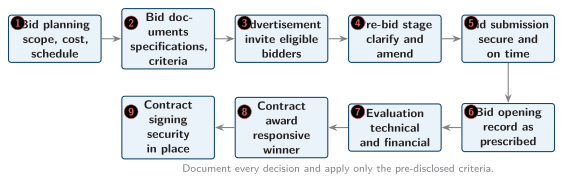
Competitive bidding process from need definition to signed contract
-
Plan the procurement: need, scope, package, estimate, market, method, and schedule.
-
Prepare specifications/terms of reference, conditions, forms, and pre-disclosed evaluation criteria.
-
Publish the invitation through required channels for the applicable period.
-
Hold a pre-bid meeting or issue clarifications/addenda without favoring a bidder.
-
Receive secure bids by the deadline; protect confidentiality before opening.
-
Open bids according to the prescribed procedure and create an opening record.
-
Evaluate responsiveness, qualification, technical compliance, and price only under disclosed rules.
-
Obtain approval and notify the award, observing any review or standstill mechanism.
-
Sign the contract after required security and conditions are satisfied.
| Test | Question |
|---|---|
| Responsiveness | Does the bid materially comply with mandatory commercial and procedural requirements? |
| Technical compliance | Does the offered solution meet the specifications and required performance? |
| Evaluated price | What is the comparable evaluated price after permitted corrections and adjustments, rather than merely the read-out price? |
| Qualification | Does the bidder have the legal status, experience, personnel, equipment, finance, and capacity required to perform? |
Core bid-evaluation tests
| Aspect | Single envelope | Two envelope |
|---|---|---|
| Contents | Technical and financial material submitted together | Technical and financial proposals separately secured |
| Opening | Submitted contents handled under one opening sequence | Financial proposal opened only for technically qualified bidders |
| Typical use | Straightforward goods or works where compliance is readily assessed | Complex procurement or consultancy where technical quality is assessed before price |
Single- and two-envelope procedures
Nepal Public Procurement Context
Section titled “Nepal Public Procurement Context”The Public Procurement Act, 2063 and Public Procurement Regulations establish the framework for public procurement in Nepal. The Public Procurement Monitoring Office (PPMO) develops standard documents, supports e-procurement, monitors the system, and performs its statutory functions. Key principles include competition, transparency, equal treatment, value for money, review, ethics, and documented decision-making.
Goods and works commonly use the lowest evaluated substantially responsive bid, not automatically the lowest quoted number. Consultancy may use quality-and-cost based selection (QCBS), quality-based selection (QBS), least-cost selection (LCS), fixed-budget selection (FBS), or individual-consultant selection as authorized and appropriate.
| Method | Decision logic | Appropriate emphasis |
|---|---|---|
| QCBS | Weighted technical and financial scores; documents often allocate about 70–80% to technical and 20–30% to financial | Balance quality and cost |
| QBS | Select on technical quality, then negotiate price | Exceptional complexity or assignments where quality dominates |
| LCS | Among proposals meeting the technical threshold, select lowest cost | Standard, routine assignments |
| FBS | Select the best technical proposal within a disclosed fixed budget | Clearly defined scope and firm budget |
| ICS | Compare qualified individual experts | Assignment suited to one specialist |
Consultancy-selection methods