Nepal Telecom
Identity and Historical Development
Section titled “Identity and Historical Development”Nepal Doorsanchar Company Limited (NDCL), known publicly by the registered brand Nepal Telecom (NT), is Nepal’s state-controlled telecommunications company. Its central office is at Doorsanchar Bhawan, Bhadrakali Plaza, Kathmandu. The former Nepal Telecommunications Corporation was transformed into NDCL on Baisakh 1, 2061 BS (13 April 2004) and registered under the then-applicable Company Act.
| AD | BS | Milestone |
|---|---|---|
| 1916 | 1973 | First telephone lines in Kathmandu and open-wire trunk link from Kathmandu to Raxaul, as listed on Nepal Telecom’s current milestone page |
| 1959 | 2016 | Telecommunication Department established |
| 1969 | 2026 | Department converted into the Telecommunications Development Board |
| 1975 | 2032 | Nepal Telecommunications Corporation established as a fully government-owned corporation |
| 2004 | 2061 | Corporation transformed into Nepal Doorsanchar Company Limited |
| 2015 | 2071/72 | FTTH service launched |
| 2017 | 2073/74 | 4G/LTE service launched |
| 2020 | 2076/77 | VoLTE launched |
| 2022 | 2078/79 | eSIM launched |
| 2025 | 2081/82 | VoWiFi launched |
Selected institutional milestones
The Government of Nepal remains the controlling shareholder. Do not memorize a legacy approximation such as “about 85%” without checking the latest audited annual report or shareholder disclosure, because the exact ownership split is a time-sensitive corporate fact.
Vision, Mission, Goal, and Objectives
Section titled “Vision, Mission, Goal, and Objectives”| Element | Official substance |
|---|---|
| Vision | Remain a dominant player in Nepal’s telecommunications sector while extending reliable and cost-effective services to all |
| Mission | Operate as a progressive, customer-spirited and responsive entity, providing reliable nationwide service that advances social, political, and economic development |
| Goal | Provide cost-effective telecommunication services to every nook and corner of the country |
Nepal Telecom’s stated direction
These statements imply six practical objectives:
-
provide reliable, affordable, and quality services in urban and rural areas;
-
expand infrastructure and universal access;
-
adopt appropriate modern technologies and improve capacity;
-
contribute taxes, dividends, employment, and infrastructure to the economy;
-
remain commercially responsive and competitive while meeting public obligations; and
-
reduce geographic, economic, and capability dimensions of the digital divide.
Governance and Organization
Section titled “Governance and Organization”Nepal Telecom uses a line-and-staff hierarchy within company-law governance. The exact names and number of offices change with approved restructuring, but the durable accountability chain is shown in the figure.
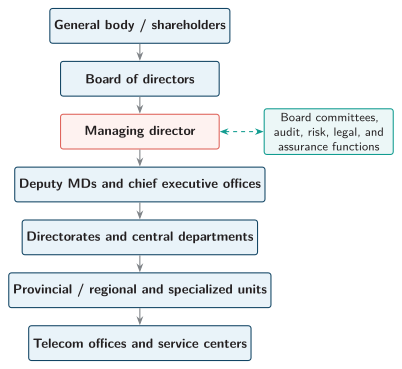
Conceptual Nepal Telecom governance and operating hierarchy
General body.
Shareholders exercise powers assigned by company law and the constitutional documents through general meetings.
Board of directors.
Directs policy, strategy, oversight, and major corporate decisions within its legal and delegated authority.
Managing director.
Serves as chief executive and is accountable for execution and day-to-day management through executive offices, directorates, departments, and field units.
Service Scope and Technology Base
Section titled “Service Scope and Technology Base”| Domain | Illustrative services |
|---|---|
| Fixed access | PSTN/voice, broadband access, FTTH, and leased connectivity |
| Mobile | GSM-family voice and data, 3G/4G-LTE, VoLTE, eSIM, and VoWiFi where offered |
| Internet and enterprise data | Broadband, leased Internet, IP-VPN, cloud or data-center-related services |
| Backbone and wholesale | National transmission/IP backbone, gateways, interconnection, transit, and capacity |
| Value-added and digital services | Messaging, intelligent-network services, television/content, applications, and digital-payment partnerships |
Major Nepal Telecom service domains
The underlying technology portfolio includes digital switching and IP-based voice, optical access and backbone, MPLS/IP core networks, microwave and satellite links for suitable terrain, mobile radio access, service platforms, charging/billing, and operations-support systems. Legacy services such as CDMA, ADSL, or ISDN should be described according to their current operational status, not assumed permanently active from older notes.
Tariff Regulation
Section titled “Tariff Regulation”Nepal Telecom is a licensee regulated by NTA. The Telecommunications Act assigns NTA the function of approving and regularizing fees charged by licensees, and Section 42 addresses service charges. A good legal answer separates:
-
the licensee’s tariff proposal and effective date;
-
NTA approval or regulatory control;
-
publication and transparency to customers;
-
fairness, reasonableness, non-discrimination, and applicable guidelines; and
-
the exact notice period and procedure in the current consolidated text.
The supplied source states submission at least three months before enforcement. Treat that as an examinable figure only when it matches the prescribed current Act, Rules, tariff guideline, or license condition.
Institutional Relationships
Section titled “Institutional Relationships”| Stakeholder | Relationship |
|---|---|
| Government of Nepal | Controlling shareholder, policy maker, tax and dividend recipient, and owner of wider public-interest objectives |
| MoCIT | Sector ministry responsible for national communication and information technology policy and government liaison |
| Nepal Telecommunications Authority | Licenses and regulates service, tariffs, quality, interconnection, spectrum-related compliance, and consumer interests |
| Customers | Purchase and use services; hold contractual and regulatory rights concerning price, quality, privacy, complaint, and continuity |
| Other operators | Compete in retail/wholesale markets and interconnect under regulatory and commercial arrangements |
| Vendors and contractors | Supply goods, works, and services under procurement, financial, integrity, and contract controls |
| Employees and unions | Deliver operations under employment law, company regulations, collective arrangements, and professional duties |
Nepal Telecom’s principal stakeholder relationships