Telecommunications and National Digital Policies
Telecommunications Policy, 2060
Section titled “Telecommunications Policy, 2060”The policy’s central aim is an environment in which reliable and affordable telecommunications becomes universally accessible and supports Nepal’s social and economic development. Its main directions are:
-
universal access across geographic and social groups;
-
private-sector participation and investment;
-
fair competition in a liberalized market;
-
rural expansion supported by the RTDF;
-
a capable and independent regulator;
-
better quality of service and appropriate modern technology; and
-
use of telecommunications to reduce the digital divide and advance development.
Policy–law connection: The policy expresses direction; the Telecommunications Act, Regulation, licenses, directives, and institutional decisions provide legal and operational mechanisms such as NTA and the RTDF.
Digital Nepal Framework, 2076 (2019)
Section titled “Digital Nepal Framework, 2076 (2019)”The Digital Nepal Framework is MoCIT’s national digital-transformation roadmap, summarized as one nation, eight sectors, 80 digital initiatives. It seeks both economic growth and solutions to social and public-service problems.
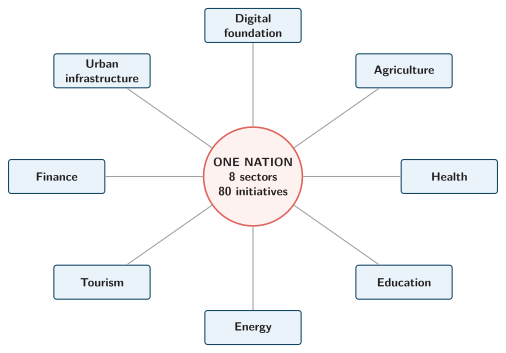
The 1–8–80 structure of the Digital Nepal Framework
| Sector | Illustrative initiatives |
|---|---|
| Digital foundation | Broadband, data centers, digital identity, platforms, interoperability, and digital payments |
| Agriculture | Farm data, smart agriculture, extension, traceability, and e-markets |
| Health | Telemedicine, digital records, surveillance, and health information |
| Education | Digital content, learning platforms, classrooms, and skills |
| Energy | Smart grid, metering, analytics, and efficient system operation |
| Tourism | Digital promotion, information, booking, e-visa, and smart destinations |
| Finance | Digital payments, fintech, inclusion, and data-enabled services |
| Urban infrastructure | Smart governance, transport, utilities, planning, and services |
Eight sectors of the Digital Nepal Framework
Its significance lies in cross-sector transformation: connectivity alone is not enough. Identity, payments, data governance, interoperability, cyber security, skills, institutions, and service redesign must operate together.
ICT Policy, 2072 (2015)
Section titled “ICT Policy, 2072 (2015)”The policy vision is to transform Nepal into an information- and knowledge-based society and economy. Its mission is to create conditions for intensified ICT sector growth as a driver of socio-economic development.
| Policy target | Original stated goal |
|---|---|
| Digital literacy | At least 75% of the population |
| Broadband access | Reach 90% of the population |
| ICT contribution to GDP | At least 7.5% |
| e-Governance | Expand digital public-service delivery |
| Employment | Generate ICT-sector jobs and capability |
Targets stated in the ICT Policy 2072 source summary
These are policy targets, not claims that the values have been achieved today. The policy helped frame broadband expansion, e-governance, digital skills, and ICT-industry development and preceded the broader Digital Nepal Framework.
National Cyber Security Policy, 2080 (2023)
Section titled “National Cyber Security Policy, 2080 (2023)”The policy seeks a safe, secure, and resilient cyberspace supported by legal, institutional, technical, and human-capacity arrangements. Its central themes are:
-
protection of national critical information infrastructure (CII);
-
prevention, detection, response, recovery, and continuity capability;
-
establishment and operation of a National Cyber Security Centre;
-
skilled human resources, awareness, research, and professional development;
-
reliable and secure digital public and private services;
-
coordination among government, security, regulators, finance, operators, academia, and the private sector; and
-
bilateral, regional, and international cooperation against cross-border risk.
The source describes an implementation committee coordinated through MoCIT’s IT leadership and involving institutions such as NTA, Nepal Rastra Bank, security agencies, and technical experts. Exact committee composition and the operational status of institutions should be checked against the current policy, implementation instruments, and government decisions.
How the Instruments Fit Together
Section titled “How the Instruments Fit Together”| Instrument | Primary role |
|---|---|
| Telecommunications Act 2053 and | |
| Regulation 2054 | Creates the regulator and binding sector mechanisms for licensing, service, spectrum-related work, tariffs, RTDF, enforcement, and appeal |
| Telecommunications | |
| Policy 2060 | Sets liberalization, competition, universal access, quality, and rural-development direction |
| ICT Policy 2072 | Frames ICT-sector growth, literacy, broadband, e-governance, and knowledge-society objectives |
| Digital Nepal Framework 2076 | Organizes 80 cross-sector transformation initiatives across eight sectors |
| National Cyber Security Policy 2080 | Adds coordinated protection, resilience, institutions, capability, and CII priorities |
| Periodic plans and annual programmes | Convert longer-term policy into time-bound priorities, projects, budgets, and indicators |
Policy stack from sector access to digital resilience