Open-Loop and Closed-Loop Control
A control system is an interconnection of components arranged to command, direct, or regulate a plant so that its output follows a desired reference. In its simplest form,
Examples include motor-speed control, room-temperature control, antenna positioning, tank-level control, aircraft autopilots, and regulated power supplies.
Basic Terminology
Section titled “Basic Terminology”| Term | Meaning |
|---|---|
| Reference input | Desired value of the output; also called the command input. |
| Controlled output | Quantity that the system must regulate. |
| Plant or process | Physical system being controlled. |
| Controller | Element that generates the control action. |
| Actuator | Device that applies control energy to the plant. |
| Sensor or feedback element | Measures the output and produces a feedback signal. |
| Error signal | Difference between the reference and feedback signals. |
| Disturbance | Unwanted input that affects the output. |
Basic control-system terms.
For the standard feedback representation,
where is the reference, is the feedback signal, and is the error. The controller acts on this error to reduce the difference between the desired and actual outputs.
Open-Loop Control
Section titled “Open-Loop Control”An open-loop control system has control action that is independent of the output. There is no feedback path and therefore no automatic correction of output error. If is the controller transfer function and is the plant transfer function, then
| System | Why it is open loop |
|---|---|
| Electric toaster | Heating time is preset; toast colour is not measured. |
| Timer-based washing machine | The cycle runs for a fixed time regardless of cleanliness. |
| Fixed-time traffic signal | Switching follows a schedule rather than measured traffic density. |
| Open-loop stepper motor | Pulses command position, but actual shaft position is not measured. |
Typical open-loop systems.
Their limitations are the absence of automatic error correction, high sensitivity to disturbances and parameter variations, reduced accuracy, frequent recalibration, and inability to compensate automatically for load changes.
Closed-Loop Control
Section titled “Closed-Loop Control”A closed-loop control system measures the output, compares it with the reference, and uses the resulting error to generate corrective action.
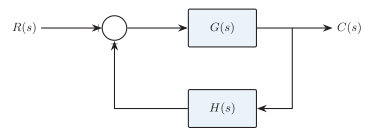
Canonical single-loop feedback system.
For the negative-feedback loop in the figure,
Substitution gives
Hence,
Closed-loop control improves accuracy, corrects errors automatically, reduces the effects of disturbances and parameter variation, increases useful bandwidth, and often improves linearity. These benefits require extra sensors and hardware; poor loop design can cause instability, and noisy feedback can inject measurement noise into the control action.
Open-Loop versus Closed-Loop Systems
Section titled “Open-Loop versus Closed-Loop Systems”| Feature | Open loop | Closed loop |
|---|---|---|
| Feedback | Absent | Present |
| Control action | Independent of output | Depends on output |
| Error correction | Not automatic | Automatic |
| Accuracy | Lower | Higher |
| Disturbance sensitivity | High | Low when designed correctly |
| Parameter sensitivity | High | Reduced by loop gain |
| Stability | No feedback-induced instability | May become unstable |
| Complexity and cost | Low | Higher |
| Calibration | Often required | Less frequent |
| Examples | Toaster, timer-based washer | Thermostat, speed control, autopilot |
Comparison of open-loop and closed-loop control.
Feedback Concepts
Section titled “Feedback Concepts”Feedback is the process of returning a measured portion of the output to the input for comparison with the reference. The comparison produces the error signal that drives the controller.
| Type | Error signal | Principal effect |
|---|---|---|
| Negative feedback | Opposes the error, usually improving accuracy and robustness when the loop has adequate stability margins. | |
| Positive feedback | Reinforces the error, increasing effective gain and tending toward oscillation or instability. |
Negative and positive feedback.
For example, let a first-order plant have constant negative feedback . Its closed-loop transfer function can be written as
The product of the forward and feedback paths is the loop gain:
Classification of Control Systems
Section titled “Classification of Control Systems”Control systems are classified independently along several axes; a given system may, for example, be nonlinear, time varying, discrete time, and MIMO at once.
Linear and Nonlinear Systems
Section titled “Linear and Nonlinear Systems”A linear system obeys homogeneity and additivity, and hence superposition:
Ideal RLC networks, small-signal amplifier models, and linearized motor models are common examples. A nonlinear system does not satisfy superposition; saturation, dead zone, backlash, relay action, diode characteristics, and magnetic hysteresis are typical nonlinearities.
Time-Invariant and Time-Varying Systems
Section titled “Time-Invariant and Time-Varying Systems”A time-invariant system has parameters that do not change with time, such as a fixed RLC network. A time-varying system has one or more time-dependent parameters; the decreasing mass of a missile as fuel burns is a standard example.
Continuous-Time and Discrete-Time Systems
Section titled “Continuous-Time and Discrete-Time Systems”| Type | Signal nature | Example |
|---|---|---|
| Continuous time | Signals are defined for every value of time. | Analog motor-speed control. |
| Discrete time | Signals are represented at distinct sampling instants. | Digital control using a microcontroller. |
Classification by the time variable.
SISO and MIMO Systems
Section titled “SISO and MIMO Systems”| Type | Meaning | Example |
|---|---|---|
| SISO | Single input, single output. | Heater temperature control. |
| MIMO | Multiple inputs, multiple outputs. | Aircraft flight-control system. |
Classification by numbers of inputs and outputs.
Regulator and Tracking Systems
Section titled “Regulator and Tracking Systems”A regulator holds its output at a prescribed value despite disturbances; a voltage regulator is the standard example. A tracking system makes its output follow a changing command, as when a radar antenna follows a target.
Deterministic and Stochastic Systems
Section titled “Deterministic and Stochastic Systems”A deterministic model has prescribed inputs and parameters with no random quantities. A stochastic model represents random inputs, parameters, or noise statistically.
Lumped and Distributed Parameter Systems
Section titled “Lumped and Distributed Parameter Systems”In a lumped-parameter model, state variables vary only with time and are described by ordinary differential equations. In a distributed-parameter model, variables also depend on spatial position and are generally described by partial differential equations.
Servomechanisms
Section titled “Servomechanisms”A servomechanism is a closed-loop control system whose controlled output is a mechanical position, velocity, or acceleration. Feedback makes that mechanical output follow the command accurately.
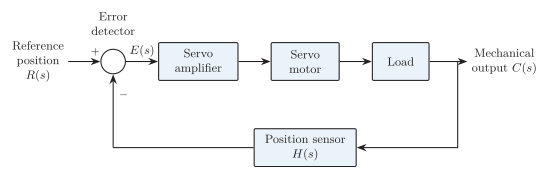
Closed-loop servo position-control system with position feedback.
In the position-control loop of the figure, the error detector compares commanded and measured positions. The amplifier raises the error signal to a useful power level, the servomotor produces mechanical motion, and the sensor closes the loop.
| Component | Function |
|---|---|
| Error detector | Compares desired and actual position. |
| Servo amplifier | Amplifies and conditions the error signal. |
| Servomotor | Converts the electrical control signal into mechanical motion. |
| Load | Mechanical system that must be positioned or driven. |
| Feedback sensor | Measures position or speed and produces the feedback signal. |
Elements of a basic servo system.
Applications include radar-antenna positioning, CNC machine tools, robotic arms, aircraft control surfaces, disk-drive head positioning, and automatic steering systems.
| Feature | DC servomotor | AC servomotor |
|---|---|---|
| Supply | DC | AC |
| Control | Armature or field control | Usually control-phase voltage |
| Response | Fast and straightforward to control | Smooth and reliable |
| Maintenance | Brushes require maintenance | Many types are brushless and need less maintenance |
| Applications | Robotics and position control | Instrument servos and low-power control |
Comparison of DC and AC servomotors.