Company Governance and Constitutional Documents
Memorandum and Articles of Association
Section titled “Memorandum and Articles of Association”| Aspect | Memorandum of Association (MoA) | Articles of Association (AoA) |
|---|---|---|
| Function | Constitutes the company and defines its identity, objects, capital, liability, and external scope | Establishes internal governance rules and procedures |
| Typical contents | Name, registered office, objectives, authorized capital, shareholder liability | Shares, calls, transfer, meetings, voting, directors, accounts, and dividends |
| Relationship | Frames the company’s capacity in relation to the outside world | Regulates relations among company, members, and governing organs |
| Hierarchy | Fundamental constitutional document under the Act | Subordinate to the Act and MoA |
| Alteration | Requires the prescribed special resolution, filing, and any approval or conditions | Usually altered by special resolution and filing, subject to the Act and MoA |
Memorandum and articles compared
Nepal Telecom’s MoA identifies Nepal Doorsanchar Company Limited, its registered office, telecommunications objectives, share capital, and limited liability. Its current capital and shareholding figures must be taken from the latest filed MoA, audited report, and shareholder disclosure.
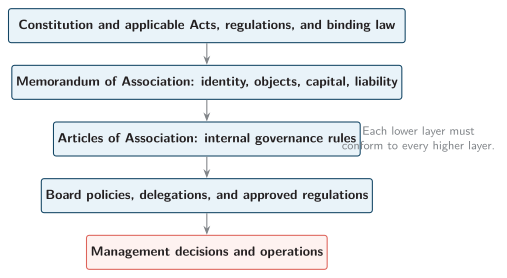
Hierarchy of company-governance authority
Company Act, 2063
Section titled “Company Act, 2063”The Company Act, 2063 governs incorporation, separate legal personality, share capital and securities, governance, accounts, audit, meetings, directors, and company administration. The supplied syllabus emphasizes Chapters 2, 3, and 5.
Incorporation
Section titled “Incorporation”A proposed company submits the prescribed application, MoA, AoA, and documents to the Office of the Company Registrar (OCR). Registration and the certificate of incorporation create a separate legal entity with perpetual succession and limited liability according to its form.
| Form | Distinguishing feature |
|---|---|
| Private company | One to 101 shareholders under the source summary; cannot invite the general public to subscribe for securities |
| Public company | At least seven promoters/shareholders under the source summary and may issue securities to the public subject to law |
| Single-shareholder company | Private company formed by one person under the statutory conditions |
| Not-for-profit company | Incorporated for permitted objectives without distributing profit to members |
Company forms summarized in the supplied notes
MoA, AoA, and prospectus
Section titled “MoA, AoA, and prospectus”The MoA and AoA form the company’s registered constitutional framework. A prospectus is the regulated disclosure by which a public company invites the public to subscribe for securities. It must be approved/registered as required, contain material information, and not mislead investors. Alteration of the constitutional documents requires the prescribed special resolution and filing or approval.
Company meetings
Section titled “Company meetings”| Matter | Source summary |
|---|---|
| Annual general meeting (AGM) | First AGM within one year of commencement; thereafter annually and generally within six months after fiscal year-end |
| Extraordinary general meeting (EGM) | Convened when urgent or special shareholder business must be decided between AGMs |
| Notice | Public-company source figures: 21 days for AGM and 15 days for EGM |
| Quorum | Source summary refers generally to at least three shareholders representing the required shareholding for a public company |
| Ordinary resolution | Passed by the applicable simple majority |
| Special resolution | Source summary uses a 75% majority for fundamental matters |
Meeting provisions in the supplied Company Act summary