Advanced Technologies: Mobile, NGN and VoIP
Mobile Communication Evolution
Section titled “Mobile Communication Evolution”Mobile systems progressed from analog voice to digital voice and messaging, then packet data and broadband multimedia. Higher generations add radio and core-network capabilities; the rate, delay, and services a user receives depend on the actual deployment, coverage, and load.
| Gen | Main technology | Services / key feature |
|---|---|---|
| 1G | Analog cellular (FM) | Voice; low security |
| 2G | GSM, IS-95 CDMA | Digital voice, SMS; encryption, more capacity |
| 2.5G | GPRS, EDGE | Always-on low-speed packet data |
| 3G | UMTS, CDMA2000 | Voice, video call, mobile internet; multimedia |
| 4G | LTE, LTE-A | All-IP broadband; OFDMA, MIMO, low latency |
| 5G | 5G NR | eMBB/URLLC/mMTC; massive MIMO, slicing |
Evolution of mobile communication from 1G to 5G
The Universal Mobile Telecommunications System (UMTS) is a 3G system standardised by 3GPP and evolved from GSM/GPRS. Its widely deployed FDD radio interface uses WCDMA for voice, data, and multimedia; UMTS also includes TDD radio variants.
-
Radio access: WCDMA uses nominal carriers and a chip rate. UTRAN comprises Node B base stations and radio network controllers (RNCs).
-
Core domains: Traditional UMTS supports circuit-switched voice through the MSC domain and packet data through SGSN/GGSN. The RNC connects through Iu-CS and Iu-PS respectively.
-
Identity and mobility: The USIM supports subscriber identity and authentication. Roaming additionally requires compatible networks, subscription support, and operator agreements.
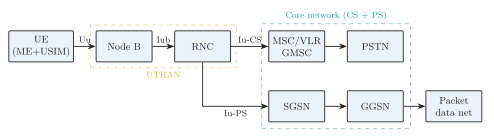
UMTS network architecture.
| Element | Function |
|---|---|
| Node B | Radio transmission/reception (base station) |
| RNC | Controls Node B; radio resource management, handover |
| MSC/VLR | Circuit-switched switching; visited-area subscriber data |
| HLR/AuC | Permanent subscriber database; authentication keys |
| SGSN | Packet mobility and session management |
| GGSN | Gateway to external packet networks |
Important UMTS elements
IMT-2000
Section titled “IMT-2000”IMT-2000 is the ITU framework for third-generation mobile systems. It defines requirements and a family of radio interfaces, including UMTS and CDMA2000, rather than a single universal air interface.
-
Service goals: High-quality mobile voice, packet data, and multimedia with improved spectrum efficiency and support for roaming across suitable networks.
-
Compatibility: Membership in the IMT-2000 family does not make different radio interfaces directly compatible. Multimode terminals and network interworking are needed when technologies differ.
The commonly quoted initial 3G target rates depend on mobility and environment; they are not guaranteed user throughput or ceilings for later 3G enhancements.
| Environment | Target rate |
|---|---|
| High mobility | |
| Pedestrian/urban | |
| Indoor/low mobility | up to |
| Interface | System |
|---|---|
| IMT-DS | Direct spread WCDMA/UMTS |
| IMT-MC | Multi-carrier CDMA/CDMA2000 |
| IMT-TC | Time-code CDMA, including UTRA TDD and TD-SCDMA |
| IMT-SC | Single carrier, UWC-136/EDGE |
| IMT-FT | Frequency time, DECT-based |
Next Generation Network (NGN)
Section titled “Next Generation Network (NGN)”A Next Generation Network (NGN) is a packet-based network that separates service control from transport and delivers voice, data and video over a common IP infrastructure, with QoS support and generalised mobility.
-
Functional separation: Packet transport forwards traffic; session control authenticates requests, routes sessions, and applies policy; application servers implement service logic. Defined interfaces allow these functions to evolve independently.
-
Convergence: Fixed and mobile access can reach common voice, data, and video services. Media and signalling gateways interwork with legacy circuit networks.
-
Transport requirements: QoS, security, and availability require provisioned capacity, scheduling, access controls, monitoring, and redundancy. They are not supplied merely by carrying packets over IP/MPLS.
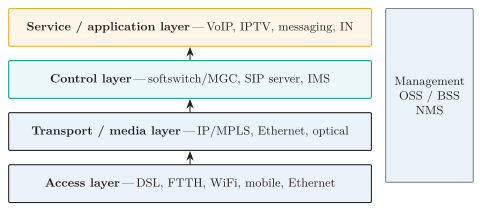
Layered architecture of an NGN.
| Component | Function |
|---|---|
| Softswitch/MGC | Software-based call/session control; controls gateways |
| Media Gateway (MGW) | Converts media between circuit (TDM/PCM) and packet (RTP) |
| Signalling Gateway | Interworks SS7 signalling with IP-based control |
| Application Server | Voicemail, conferencing, IN, IPTV logic |
| Session Border Ctrl. | Border security, NAT traversal, admission, topology hiding |
Main NGN components
Voice over IP (VoIP) carries coded speech in packets over an IP network.
-
Signalling path: Exchanges session requests, responses, and media descriptions to establish, modify, and release a call.
-
Media path: Carries the speech packets between media endpoints, sometimes through a gateway or relay. A signalling proxy need not be on that path.
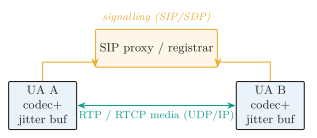
VoIP signalling and media paths.
Protocol Stack
Section titled “Protocol Stack”-
SIP: Session Initiation Protocol carries call signalling over transports such as UDP, TCP, or TLS over TCP. SDP offers and answers describe media formats, receiving addresses, and ports. H.323 is an alternative call-control framework.
-
RTP and RTCP: RTP normally carries speech over UDP/IP; RTCP supplies reception-quality reports and timing information.
-
Protection: TLS protects a SIP transport connection, not the associated RTP stream. Media protection requires a mechanism such as SRTP and suitable key establishment.
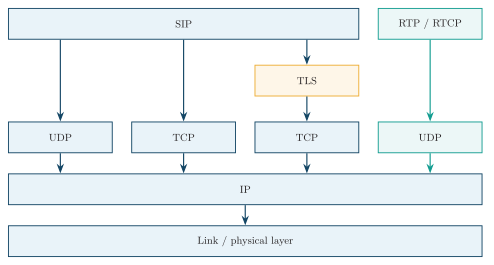
SIP-based VoIP protocol stack.
Voice Coding and Quality
Section titled “Voice Coding and Quality”| Codec | Notes | Bit rate |
|---|---|---|
| G.711 | PCM, high quality, high bandwidth | |
| G.729 | Compressed, common in VoIP | |
| G.723.1 | Low bit rate | / |
| AMR | Mobile networks | variable |
-
Processing chain: Speech coding packetisation network transport jitter buffering decoding playout.
-
Quality trade-offs: Longer packetisation intervals reduce header overhead but add delay and make each lost packet remove more speech. A larger jitter buffer tolerates greater arrival variation but also delays playout. Codec distortion, packet loss, late arrivals, and echo affect perceived quality.
PC-to-Ordinary-Phone Call Flow
Section titled “PC-to-Ordinary-Phone Call Flow”A PC-to-ordinary-phone call crosses two bearer domains. The IP side carries packetised speech using RTP/UDP/IP, whereas the PSTN side carries speech on a circuit bearer, normally PCM/TDM in the digital network. The VoIP gateway, together with its associated call-control and signalling functions, forms the boundary between them.
Figure separates call setup from the bidirectional speech path and call release.

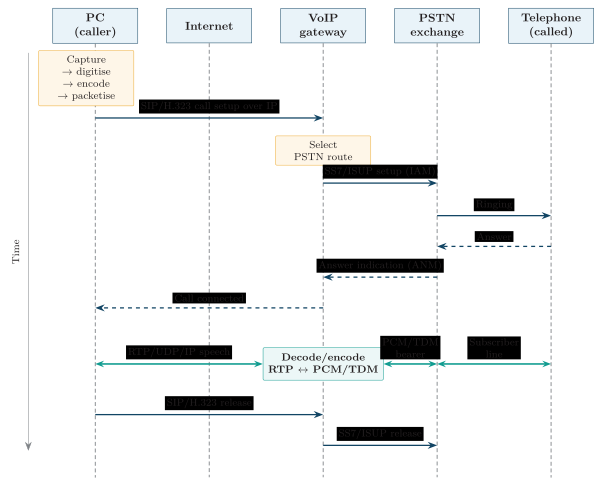
PC-to-ordinary-phone VoIP call flow across an IP–PSTN gateway.
-
Capture and packetisation: The PC microphone captures speech; an ADC samples it, a codec such as G.711 or G.729 encodes it, and the softphone places the coded frames in RTP/UDP/IP packets.
-
IP-side setup: When the user dials the telephone number, the softphone sends SIP or H.323 call-control signalling through the Internet toward the gateway or its call server.
-
Gateway interworking: The gateway control function interprets the destination number, selects a PSTN route, and maps the IP session state to PSTN signalling such as SS7/ISUP.
-
PSTN setup and alerting: The PSTN establishes a circuit toward the terminating exchange, which applies ringing to the called telephone and returns an alerting indication.
-
Answer: Going off-hook produces an answer indication. The gateway completes the SIP/H.323 setup toward the PC, and the conversation phase begins.
-
PC-to-phone speech: The gateway receives RTP packets, removes IP/UDP/RTP headers, compensates for jitter, decodes or transcodes the speech, and supplies PCM samples to the PSTN bearer.
-
Phone-to-PC speech: In the reverse direction, the gateway encodes the incoming PSTN speech and packetises it into RTP/UDP/IP. Speech therefore flows simultaneously in both directions.
-
Release: When either party hangs up, SIP
BYEor the corresponding H.323 procedure is interworked with PSTN release signalling; the IP session and the PSTN circuit are cleared.
SIP Call Establishment and Release
Section titled “SIP Call Establishment and Release”In a basic offer-in-INVITE exchange, the caller sends INVITE with SDP, the destination accepts with 200 OK and an SDP answer, and the caller sends ACK. Provisional responses report progress. Media uses the negotiated endpoints, not necessarily the proxy route; some call flows also establish early media before the final answer.
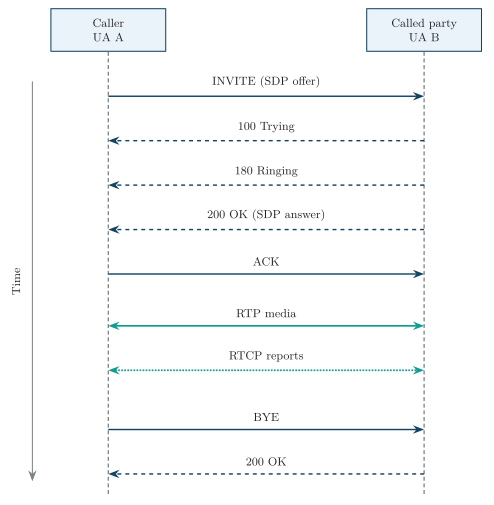
SIP call establishment and release.
| Message | Function |
|---|---|
INVITE | Requests a session; the SDP offer proposes media formats and receiving addresses/ports |
100 Trying | Reports request processing; this provisional response is not required in every successful exchange |
180 Ringing | Indicates that the called user is being alerted |
200 OK to INVITE | Accepts the session; in this exchange it carries the SDP answer |
ACK | Acknowledges the successful final response to INVITE |
BYE | Terminates an established session; either endpoint may initiate it |
200 OK to BYE | Completes the release transaction; no further ACK is sent |
Real-time Transport Protocol (RTP)
Section titled “Real-time Transport Protocol (RTP)”-
Media framing: RTP identifies the payload format, packet sequence, media sampling time, and source so the receiver can detect missing or reordered packets and schedule playout.
-
Control reports: RTCP reports loss and interarrival jitter, identifies sources, and relates RTP media timestamps to a reference clock. These reports inform applications; RTCP does not reserve network capacity.
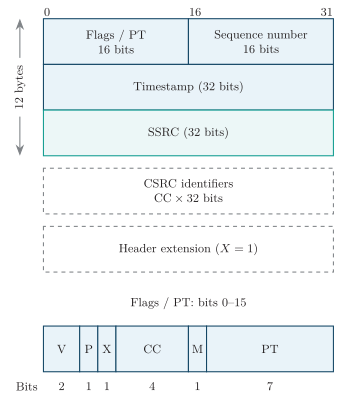
RTP packet header.
| Field | Width | Function |
|---|---|---|
| V | bits | Protocol version, normally 2 |
| P | bit | Indicates padding at the end of the packet |
| X | bit | Indicates a header extension after the CSRC list |
| CC | bits | Number of CSRC identifiers, from 0 to 15 |
| M | bit | Profile-defined marker, such as a significant media boundary |
| PT | bits | Payload format identifier, interpreted through the applicable profile or negotiated mapping |
| Sequence number | bits | Increases by one per transmitted RTP packet; supports loss and reordering detection |
| Timestamp | bits | Sampling instant in the payload’s clock units |
| SSRC | bits | Identifies the synchronisation source within the RTP session |
| CSRC list | bits | Identifies contributing sources, typically added by a mixer |
The fixed RTP header is 12 bytes. With contributing sources and no extension, its length is bytes; a header extension adds its own header and data. Padding, if present, is at the end of the packet, not part of this header length.
For G.711 with an 8 kHz timestamp clock and 20 ms packetisation, the timestamp increment is
DECT (Digital Enhanced Cordless Telecommunications) is a digital cordless technology for short-range wireless voice (cordless phones, wireless PBX), using TDMA/TDD.
-
Access: Portable handsets share time slots with a fixed base station, using time-division duplexing for the two directions. Cordless PBX deployments can support handover between coordinated base stations.
-
Capabilities and limits: Low-power handsets suit building-scale voice coverage. Authentication and encryption are available, but actual protection depends on the equipment and configuration; digital transmission alone does not ensure security.
GSM (Global System for Mobile Communications) is a 2G digital cellular system based on FDMA carriers and TDMA slots, normally using GMSK.
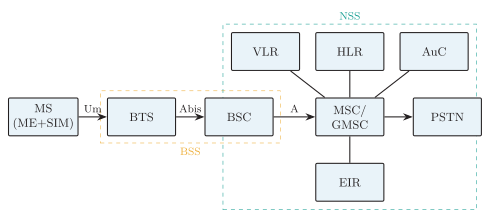
GSM network architecture.
| Element | Function |
|---|---|
| BTS | Radio transmission with mobiles |
| BSC | Controls multiple BTSs; handover, frequency management |
| MSC | Call switching and mobility management |
| HLR / VLR | Permanent / temporary (roaming) subscriber database |
| AuC | Authentication and ciphering keys |
| EIR | IMEI-based equipment status database |
Important GSM elements
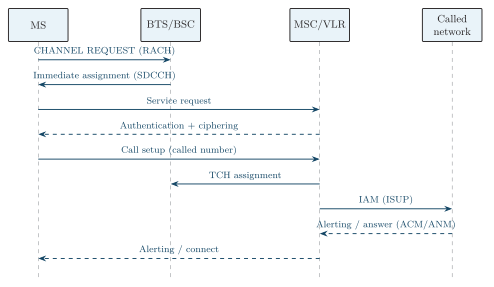
GSM mobile-originated call sequence.
-
The mobile requests access on RACH. The network returns an immediate assignment on AGCH, normally assigning an SDCCH for call setup.
-
The mobile sends a service request and identity. The network performs authentication and enables ciphering according to policy; equipment checks may also occur.
-
The mobile supplies the called number. The MSC selects a route and sends inter-exchange setup signalling, such as ISUP IAM for a PSTN destination.
-
The BSC assigns a TCH and forwards call progress. Answer establishes the conversational phase; the exact TCH-assignment timing depends on the call procedure.
-
Disconnect and release signalling clear the radio resources and associated core-network connection.
GSM supports telephony, emergency calls, SMS, circuit-switched data, and supplementary services such as forwarding and call waiting. GPRS and EDGE add packet-data access.
CDMA2000-1x
Section titled “CDMA2000-1x”-
System: CDMA2000-1x evolved from IS-95 and uses nominal carriers to support voice, SMS, and packet data.
-
Code-domain sharing: Multiple users occupy the same carrier at the same time. Spreading and channelisation codes, timing, and receiver correlation separate the desired signal from other users.
-
Soft handoff: A mobile can maintain compatible same-frequency radio links with more than one base station during a transition, reducing interruption and providing diversity.
-
Interference rejection: Despreading correlates the desired signal with its code while spreading uncorrelated narrowband interference over a wider band. A larger processing gain can improve interference tolerance, but does not create extra signal energy or guarantee secrecy.
-
Capacity and power control: Reuse of the same carrier across cells increases interference. A strong nearby user can overwhelm weaker users unless transmit powers are controlled; capacity is limited by the resulting interference and required signal quality.
-
Receiver cost: Code acquisition, tracking, multipath processing, and power-control loops add complexity compared with separating users into independent narrowband channels.
DS-SS vs FH-SS
Section titled “DS-SS vs FH-SS”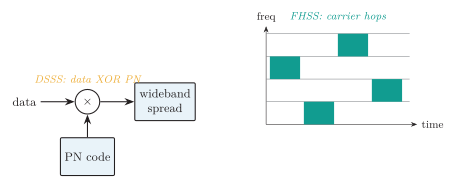
Direct-sequence and frequency-hopping spread spectrum.
| Feature | DS-SS | FH-SS |
|---|---|---|
| Instantaneous signal | Wideband, continuous | Narrowband on one hop |
| Rejection | Correlation / processing gain | Avoidance across hops |
| Near-far | Sensitive; power control in multiuser systems | Hop collisions and strong interferers still matter |
| Multipath | Rake can combine resolvable paths | Frequency diversity; equalisation may still be needed |
| Complexity | Wideband Rx, power control | Fast frequency synthesizer |
| Applications | CDMA (IS-95, CDMA2000, UMTS), GPS | Bluetooth, military, GSM slow FH |
Direct-sequence vs frequency-hopping spread spectrum
DS-CDMA Synchronization
Section titled “DS-CDMA Synchronization”-
Code alignment: The receiver must reproduce the incoming spreading sequence at the correct chip rate and phase. A misaligned code gives weak correlation and loses despreading gain.
-
Acquisition: A serial/sliding correlator or matched filter searches candidate delays and, where necessary, frequency offsets. A sufficiently strong correlation peak identifies a candidate lock point, which must be confirmed against noise and false peaks.
-
Tracking: A delay-lock loop compares early and late correlators around the prompt estimate. An error such as adjusts the local code clock to keep the peak centred. Carrier and symbol synchronisation are also required for demodulation.
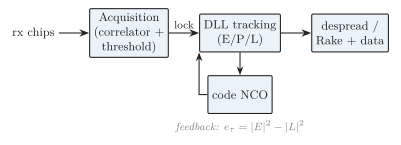
DS-CDMA code acquisition and tracking.
WiFi and WiMAX
Section titled “WiFi and WiMAX”WiFi provides wireless LAN access using IEEE 802.11, commonly in 2.4, 5, or 6 GHz bands according to version and regulation. Stations use contention-based access, with scheduled multiuser transmissions in newer versions. WiMAX uses IEEE 802.16 for broadband access, with a base station scheduling subscriber service flows.
| Standard | Band | Key feature |
|---|---|---|
| 802.11b | 2.4 GHz | up to |
| 802.11a | 5 GHz | OFDM, up to |
| 802.11g | 2.4 GHz | up to |
| 802.11n | 2.4/5 GHz | MIMO, higher throughput |
| 802.11ac | 5 GHz | wider channels, MU-MIMO |
| 802.11ax | 2.4/5/6 GHz | WiFi 6/6E, OFDMA |
| Feature | WiFi | WiMAX |
|---|---|---|
| Standard | IEEE 802.11 | IEEE 802.16 |
| Coverage | LAN / hotspot | MAN / metropolitan |
| Main use | Local networking | Broadband access / backhaul |
| QoS | WMM priorities; newer versions add scheduled multiuser access | Scheduled service flows with traffic parameters |
| Mobility | Roaming between access points | Fixed (802.16-2004) and mobile (802.16e) profiles |
| Deployment | Homes, offices, campus | ISP access, rural broadband |
WiFi vs WiMAX
Technology Comparison
Section titled “Technology Comparison”| Technology | Access | Main use |
|---|---|---|
| DECT | TDMA/TDD | Cordless telephony |
| GSM | FDMA/TDMA | Digital voice, SMS (2G) |
| UMTS | WCDMA | Mobile multimedia (3G) |
| CDMA2000-1x | CDMA | Voice and packet data (3G) |
| WiFi | CSMA/CA, OFDM(A) | Local wireless internet (WLAN) |
| WiMAX | OFDM/OFDMA | Broadband wireless access (WMAN) |
| NGN | IP/MPLS packet | Converged services |
| VoIP | RTP over IP | Voice over packet network |
Advanced technology comparison