Loss, Dispersion, Sources and Detectors
Attenuation in Optical Fibre
Section titled “Attenuation in Optical Fibre”Attenuation is the reduction of optical power with distance, expressed in dB/km.
| Cause | Mechanism |
|---|---|
| Material absorption | Impurity/molecular absorption converts light to heat |
| Rayleigh scattering | Scattering from microscopic density variations () |
| Bending loss | Macrobend (tight cable bend) and microbend (pressure/stress) |
| Connector loss | Misalignment, air gap, dirt, Fresnel reflection |
| Splice loss | Imperfect fusion/mechanical alignment |
Main causes of fibre attenuation.
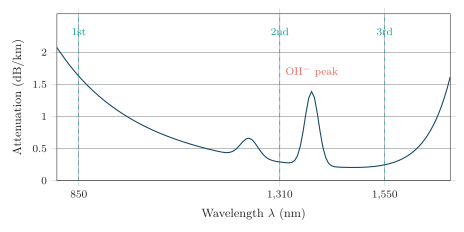
Silica attenuation spectrum: Rayleigh scattering falls as , the OH peak sits near 1383 nm, and infrared absorption rises beyond 1600 nm. The three low-loss windows are 850, 1310 and 1550 nm ().
Dispersion in Optical Fibre
Section titled “Dispersion in Optical Fibre”Dispersion is temporal spreading of a pulse as it travels; excessive spreading overlaps adjacent pulses and causes inter-symbol interference (ISI), limiting the bit-ratedistance product.
| Type | Cause | Mainly in |
|---|---|---|
| Modal | Different modes travel different path lengths | Multimode |
| Material | Index varies with wavelength | SMF & MMF |
| Waveguide | Propagation constant depends on geometry/ | SMF |
| Chromatic | Material waveguide combined | SMF |
| PMD | Two polarizations travel at slightly different speeds | High-speed links |
Types of dispersion.
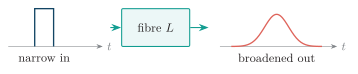
Dispersion broadens a narrow input pulse; when broadening approaches the bit period, ISI results.
Graded-index fibre reduces modal dispersion because outer rays travel faster in the lower-index glass. Chromatic dispersion dominates high-speed single-mode links and is managed with narrow-linewidth lasers, dispersion-shifted fibre or dispersion compensation.
Optical Sources: LED and Laser Diode
Section titled “Optical Sources: LED and Laser Diode”An optical source converts drive current into light. Photon energy is
so the semiconductor bandgap is chosen to match a fibre window.
-
LED: forward-biased p–n junction; spontaneous emission gives incoherent, broad-spectrum light; low cost, robust, best for short multimode links.
-
Laser diode: above the threshold current, population inversion and the cleaved-facet cavity make stimulated emission dominate, giving coherent, narrow-spectrum, high-power light for long single-mode links.
| Feature | LED | Laser diode |
|---|---|---|
| Emission | Spontaneous | Stimulated |
| Light | Incoherent | Coherent, directional |
| Spectrum | Broad | Narrow |
| Output power | Low–moderate | High |
| Modulation speed | Low–moderate | Very high |
| Threshold | None | Has threshold current |
| Temperature sensitivity | Low | High |
| Best suited for | Short MMF links | Long SMF, DWDM |
LED versus laser diode.
Photodetectors
Section titled “Photodetectors”A photodetector converts incident optical power into photocurrent, ideally .
PIN Photodiode
Section titled “PIN Photodiode”A reverse-biased p–i–n diode: photons absorbed in the wide intrinsic layer create electron–hole pairs that the field sweeps out as photocurrent. No internal gain, low noise, fast, simple biasing.
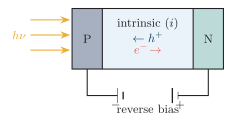
PIN photodiode in which light is absorbed in the wide intrinsic region and the reverse field sweeps carriers to the terminals ().
Avalanche Photodiode (APD)
Section titled “Avalanche Photodiode (APD)”An APD adds a very-high-field multiplication region: primary carriers gain enough energy to create secondary pairs by impact ionization, giving internal gain so . Higher sensitivity, but higher bias, more noise and temperature sensitivity.
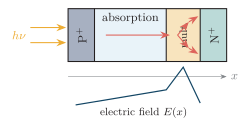
Avalanche photodiode in which primary carriers from the absorption region undergo impact-ionization gain in a high-field multiplication region ().
| Feature | PIN | APD |
|---|---|---|
| Internal gain | None () | Avalanche gain () |
| Sensitivity | Moderate | High |
| Bias voltage | Low | High |
| Noise | Low | Higher (multiplication noise) |
| Cost / complexity | Low / simple | High / bias control |
| Typical use | Short–medium links | Long links, weak signals |
PIN versus APD photodiode.
Optical Transmitter and Receiver
Section titled “Optical Transmitter and Receiver”The complete link converts coded electrical data to light, transports it through fibre, and reconstructs the electrical output after photodetection.

Complete optical link from line coding and source drive through fibre transmission to photodetection, amplification, filtering, and decision.