Fundamentals
Satellite communication uses an artificial satellite as a repeater or relay that receives an uplink, amplifies, frequency-converts and processes it in a transponder, and retransmits a downlink to one or more earth stations.
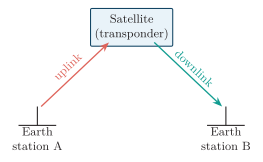
Satellite link: earth station A transmits an uplink; the transponder relays a downlink to earth station B.
| Term | Meaning |
|---|---|
| Uplink | Earth station satellite |
| Downlink | Satellite earth station |
| Transponder | Receives, amplifies, converts frequency and retransmits |
Typical uses: TV/radio broadcasting; long-distance telephony and data; Internet backbone and rural connectivity; VSAT networks for banks and remote sites; mobile satellite services; and navigation, weather, remote sensing and disaster communication.
| Advantage | Reason |
|---|---|
| Wide coverage | One satellite covers a very large area |
| Broadcast capability | The same signal reaches many receivers at once |
| Reaches remote areas | No terrestrial cable infrastructure needed |
| Rapid deployment | Suited to emergency and temporary networks |
| Distance-insensitive cost | Cost varies little with distance within coverage |
Advantages of satellite communication.
| Limitation | Reason |
|---|---|
| High propagation delay | Long path, especially GEO ( round trip) |
| High space-segment cost | Launch and satellite construction are expensive |
| Large free-space loss | Very long distance high path loss |
| Rain attenuation | Serious at Ku/Ka and higher bands |
| Limited satellite power | Transponder power and bandwidth are finite |
Limitations of satellite communication.