Total Internal Reflection and Snell’s Law
Optical Fibre Communication
Section titled “Optical Fibre Communication”Optical fibre communication transmits information as modulated light through a thin transparent dielectric waveguide of glass or plastic, guided by total internal reflection at the core–cladding boundary.
A basic link converts the electrical message to light, guides it through the fibre, and converts it back to electrical form at the receiver.

Optical fibre communication system: electrical input source driver optical source fibre channel photodetector receiver electronics recovered output.
Structure of an Optical Fibre
Section titled “Structure of an Optical Fibre”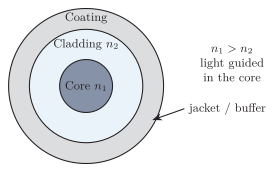
Fibre cross-section: high-index core (), lower-index cladding () and a protective coating/jacket.
| Part | Function |
|---|---|
| Core | Central region () where light propagates by TIR |
| Cladding | Surrounds core with lower index (); confines light |
| Coating / jacket | Plastic layer giving mechanical and moisture protection |
Three parts of an optical fibre.
Advantages and Limitations
Section titled “Advantages and Limitations”Refraction and Refractive Index
Section titled “Refraction and Refractive Index”The refractive index of a medium measures how much it slows light:
where is the speed of light in vacuum and its speed in the medium. A larger means slower light. When light crosses a boundary between media of different index, it changes direction (refraction).
Snell’s Law and the Critical Angle
Section titled “Snell’s Law and the Critical Angle”For light passing from a denser to a rarer medium () the refracted ray bends away from the normal. At the critical angle the refracted ray grazes the boundary ():
Total Internal Reflection
Section titled “Total Internal Reflection”Total internal reflection (TIR) is the complete reflection of light back into the denser medium, occurring when (i) light travels from higher to lower index () and (ii) the incidence angle exceeds the critical angle ().
In a fibre the core index slightly exceeds the cladding index, so rays launched within the acceptance cone strike the boundary above and are guided along the core by repeated TIR.
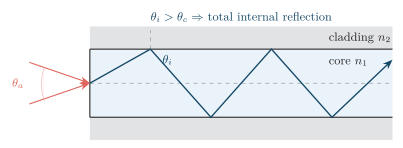
Rays entering within the acceptance angle undergo repeated total internal reflection and stay confined to the core; steeper rays refract into the cladding and are lost.