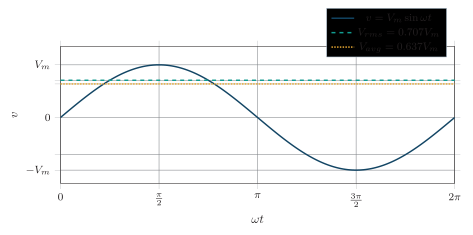
One cycle of a sinusoid with the RMS (equal-heating) and rectified average levels.
Mains “230 V, 50 Hz” is the RMS value, so Vm=2×230≈325V.
| Element | Impedance | Phase | Avg. power |
|---|
| R | Z=R | V,I in phase | P=I2R |
| L | Z=jXL, XL=2πfL | I lags V by 90∘ | 0 |
| C | Z=−jXC, XC=2πfC1 | I leads V by 90∘ | 0 |
Impedance and phase of the three elements. Mnemonic: CIVIL.
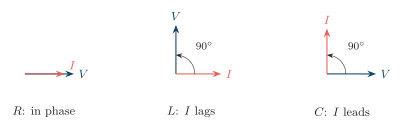
Voltage–current phasor relations for the three elements.
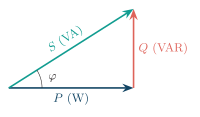
Power triangle (lagging load): S2=P2+Q2, cosφ=P/S.
| Property | Series resonance | Parallel resonance |
|---|
| Impedance | Minimum (=R) | Maximum (=L/CR) |
| Current | Maximum | Minimum |
| Called | Acceptor circuit | Rejector (tank) circuit |
Series vs parallel resonance.
A balanced three-phase source gives three equal voltages 120∘ apart:
vR=Vmsinωt,vY=Vmsin(ωt−120∘),vB=Vmsin(ωt−240∘),
whose instantaneous sum is zero, giving constant total power.
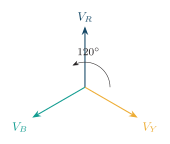
Balanced three-phase voltage phasors, 120∘ apart.
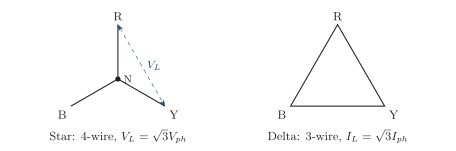
Three-phase star and delta connections.
| Feature | Single-phase | Three-phase |
|---|
| Conductors | 2 (P + N) | 3 or 4 |
| Voltage (Nepal) | 230 V | 400 V line / 230 V phase |
| Instantaneous power | Pulsating | Constant (balanced) |
| Motor starting | Needs aux. winding | Self-starting |
| Transmission economy | Poorer | Approximately 25% conductor saving |
Single-phase vs three-phase. Benefits of 3ϕ: constant torque, self-starting motors, conductor saving, smaller machines, both 400/230 V available.