Quality Management
Quality is the degree to which a set of inherent characteristics fulfills requirements. In management practice it combines conformance, fitness for use, reliability, and the customer’s experienced value.
Major Quality Thinkers
Section titled “Major Quality Thinkers”| Thinker | Contribution |
|---|---|
| W. Edwards Deming | Fourteen points, PDCA/PDSA learning cycle, variation and the system of profound knowledge |
| Joseph M. Juran | Fitness for use and the quality trilogy: planning, control, and improvement |
| Philip B. Crosby | Conformance to requirements, zero-defects standard, and the cost of nonconformance |
| Kaoru Ishikawa | Cause-and-effect diagram, quality circles, and company-wide quality control |
| Genichi Taguchi | Robust design and the loss imposed on society by variation from target |
Quality thinkers and their signature contributions
Total Quality Management
Section titled “Total Quality Management”Total Quality Management (TQM) is an organization-wide management philosophy in which leadership and all employees continuously improve processes to satisfy customers and other stakeholders over the long term.
| Principle | Operational meaning |
|---|---|
| Customer focus | Translate present and future customer needs into requirements |
| Total employee involvement | Enable everyone to identify and solve quality problems |
| Process approach | Manage related activities as measurable processes rather than isolated outputs |
| Continuous improvement | Use repeated learning and small or breakthrough change to raise performance |
| Fact-based decisions | Distinguish signal from opinion using valid data and analysis |
| System integration | Align processes, suppliers, functions, and objectives |
| Leadership commitment | Set purpose, remove fear and barriers, provide resources, and model the desired culture |
Principles of TQM
Deming’s PDCA Cycle
Section titled “Deming’s PDCA Cycle”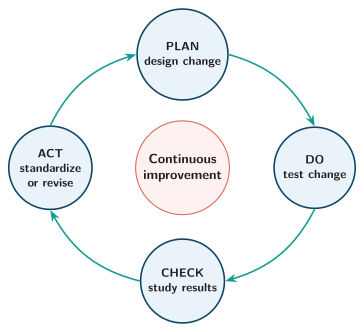
Deming’s repeating Plan–Do–Check–Act learning cycle
Plan.
Define the problem and customer need, study the current process, identify causes, set a target, and design a testable change.
Do.
Implement the change on a controlled scale and collect data.
Check.
Compare observed results with the prediction; examine intended and unintended effects.
Act.
Standardize and expand a successful change, or revise the theory and begin another cycle.
Deming’s Fourteen Points
Section titled “Deming’s Fourteen Points”-
Create constancy of purpose for improving products and services.
-
Adopt the new philosophy of quality and learning.
-
Cease dependence on mass inspection by building quality into the process.
-
End purchasing based on price alone; manage total cost and supplier quality.
-
Improve every process constantly and forever.
-
Institute effective training on the job.
-
Institute leadership that helps people and systems perform.
-
Drive out fear so that problems and ideas can be reported honestly.
-
Break down barriers between departments.
-
Eliminate slogans and exhortations that ignore system causes.
-
Eliminate arbitrary numerical quotas and management by numbers alone.
-
Remove barriers that rob people of pride in workmanship.
-
Institute vigorous education and self-improvement.
-
Engage everyone in accomplishing the transformation.
Seven Basic Quality Tools
Section titled “Seven Basic Quality Tools”| Tool | Primary use |
|---|---|
| Cause-and-effect (Ishikawa) diagram | Organize possible root causes under meaningful categories |
| Check sheet | Collect occurrence data consistently at the source |
| Control chart | Separate common-cause from special-cause variation over time |
| Histogram | Display the shape, spread, and center of a distribution |
| Pareto chart | Rank categories to focus on the vital few contributors |
| Scatter diagram | Explore association between two measured variables |
| Flowchart | Map process sequence, decisions, handoffs, delay, and rework |
The seven basic quality tools
Inference caution: A Pareto ranking does not prove root cause, and a scatter pattern does not by itself prove causation. Use the tools as parts of disciplined investigation.
Six Sigma and DMAIC
Section titled “Six Sigma and DMAIC”Six Sigma is a data-driven improvement approach aimed at reducing variation and defects. The often-cited long-term benchmark is approximately defects per million opportunities under the conventional shift assumption.
| Phase | Central question | Typical output |
|---|---|---|
| Define | What problem and customer requirement matter? | Charter, voice of customer, scope, critical-to-quality measures |
| Measure | How does the current process perform? | Operational definitions, validated measurement system, baseline |
| Analyze | What root causes explain the performance gap? | Tested cause model |
| Improve | Which solution removes or controls causes? | Piloted and optimized process change |
| Control | How will gains be sustained? | Control plan, ownership, monitoring, standard work, response plan |
DMAIC improvement roadmap
ISO 9001 Quality Management System
Section titled “ISO 9001 Quality Management System”ISO 9001 specifies auditable requirements for a quality management system. It does not certify that every individual product is flawless; it certifies that the organization operates a conforming management system within its stated scope.
| Principle | Emphasis |
|---|---|
| Customer focus | Understand needs, meet requirements, and enhance satisfaction |
| Leadership | Create unity of purpose, direction, and enabling conditions |
| Engagement of people | Develop and empower competent people at all levels |
| Process approach | Manage interacting processes as a coherent system |
| Improvement | Maintain an ongoing focus on better performance |
| Evidence-based decisions | Base decisions on analysis and reliable information |
| Relationship management | Manage interested-party and supplier relationships for sustained success |
Seven quality-management principles behind ISO 9001