CPM and PERT Network Scheduling
Critical Path Method
Section titled “Critical Path Method”The Critical Path Method (CPM) is a deterministic network-scheduling technique that calculates activity timing and identifies the longest-duration path through the network. That path determines the minimum project duration under the stated logic and durations.
| Quantity | Symbol | Calculation |
|---|---|---|
| Earliest start | Maximum among immediate predecessors | |
| Earliest finish | ||
| Latest finish | Minimum among immediate successors | |
| Latest start | ||
| Total float | ||
| Free float |
CPM timing quantities
Here is activity duration. With the usual finish constraint, a critical activity has zero total float. A delay to a critical activity delays project completion unless time is recovered elsewhere or the network logic changes.
CPM procedure
Section titled “CPM procedure”-
List activities, durations, and precedence relationships.
-
Draw a valid activity-on-node or activity-on-arrow network.
-
Make a forward pass from left to right to calculate and .
-
Make a backward pass from right to left to calculate and .
-
Calculate total and free float; trace the continuous zero-float path(s).
-
Check calendar, resource, and constraint assumptions before baselining.
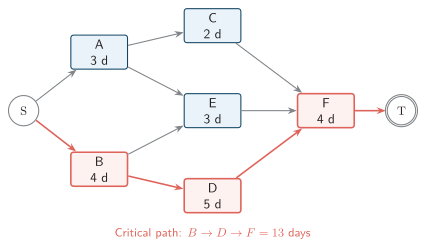
Activity-on-node network for the CPM example
Program Evaluation and Review Technique
Section titled “Program Evaluation and Review Technique”The Program Evaluation and Review Technique (PERT) is a probabilistic network technique that represents uncertain activity duration by optimistic, most likely, and pessimistic estimates.
| Estimate | Symbol | Interpretation |
|---|---|---|
| Optimistic | Plausible minimum duration under favorable conditions | |
| Most likely | Modal duration under normal conditions | |
| Pessimistic | Plausible maximum duration under unfavorable conditions |
PERT three-point estimates
| Feature | CPM | PERT |
|---|---|---|
| Duration model | One deterministic estimate | Three estimates summarized by an expected value and variance |
| Typical context | Repetitive or well-understood work such as construction | Novel, research, or uncertain work |
| Main emphasis | Schedule logic and time–cost trade-off | Duration uncertainty and completion probability |
| Limitation | Precision may conceal uncertain inputs | Approximation assumes a distribution and may ignore path switching and correlation |
CPM and PERT compared